
The purchasing power parity formula is one line of math. Two numbers, one division, one multiplication, done. But the simplicity hides something important: the same formula produces meaningfully different results depending on which version of PPP data you feed it. GDP-based factors, consumption-based factors, and sector-specific factors all exist, and they do not agree with each other. Most articles skip over that completely.
The Purchasing Power Parity Formula for Salary Comparison
The purchasing power parity formula calculates equivalent salary by multiplying your income by the ratio of two countries’ PPP conversion factors.
You need just two PPP conversion factors and one salary figure.
Equivalent Salary = Input Salary x (Target Country PPP Factor / Source Country PPP Factor)
Every country has a PPP conversion factor published by the World Bank. The United States serves as the baseline with a factor of 1.00. Every other country’s factor represents how many units of local currency buy the same basket of goods that one US dollar buys in the United States.
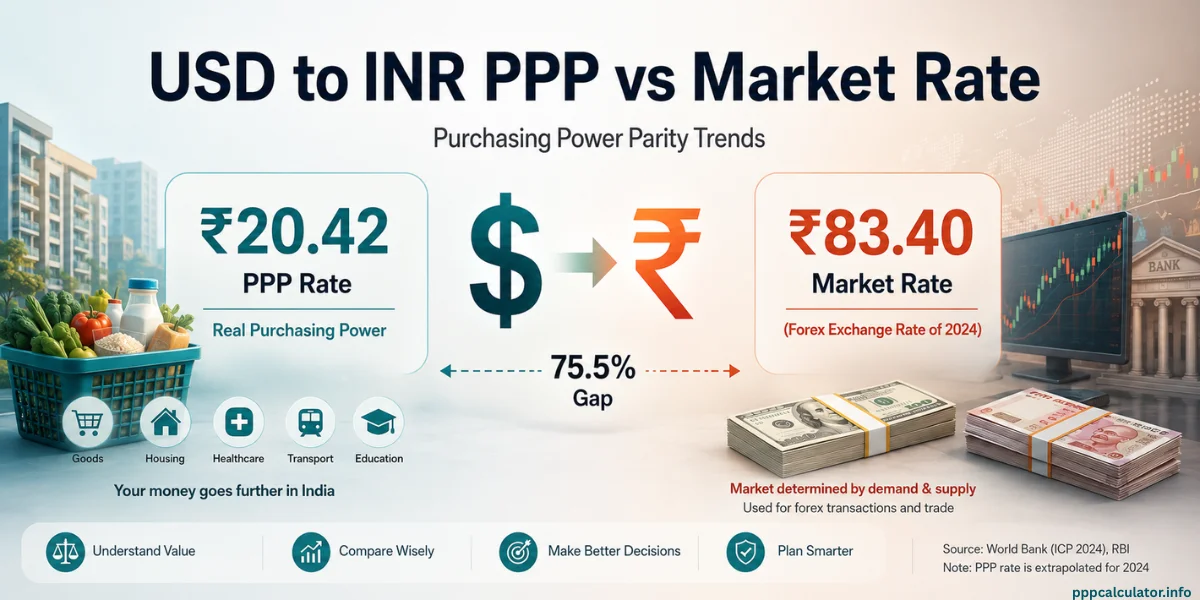
India’s PPP factor is 20.20. This doesn’t mean 20.20 rupees equal one dollar on currency markets. The market exchange rate sits around 90rupees per dollar, more than four times higher. What 20.20 means is that 20.20 rupees in India buys the same real-world basket of goods and services that one dollar buys in the United States. The gap between 20.20 and 85 exists because services, housing, food, and transportation cost far less in India relative to the US.
The World Bank’s International Comparison Program publishes these factors annually. If you want a deeper explanation of why PPP and exchange rates diverge so dramatically, our PPP vs exchange rate guide walks through the economics.
How the Formula Works Across Different Salary Levels
Running the numbers across a few real scenarios makes the purchasing power parity formula click. Notice that it works between any two countries directly. You don’t need the US dollar as a middleman.
$100,000 in the USA to India
A US-based professional earning $100,000 wants to know what equivalent purchasing power looks like in India.
Equivalent = $100,000 x (20.202558 / 1.000000) = ₹20,20,256
Roughly ₹20.2 lakhs. If an Indian offer exceeds ₹20.2 lakhs, the candidate gains purchasing power by moving. If it falls below, they lose it.
€65,000 in Germany to India
Neither country is the United States here, so both PPP factors come into play.
Equivalent = €65,000 x (20.202558 / 0.728102) = ₹18,03,547
Roughly ₹18 lakhs provides equivalent purchasing power. Germany’s PPP factor (0.728) sits below 1.00 because the euro buys more per unit than the dollar in real purchasing power terms.
£50,000 in the UK to USA
Equivalent = £50,000 x (1.000000 / 0.682911) = $73,216
The UK’s PPP factor of 0.683 means a pound stretches further than a dollar in purchasing power. So the equivalent US salary is higher than what a simple currency conversion would suggest. If the New York offer is $70,000, it actually represents a slight decrease in buying power despite looking like more money on paper.
| Source Salary | Source Country | Target Country | PPP Equivalent |
|---|---|---|---|
| $100,000 | USA | India | ₹20.2 lakhs |
| ₹30 lakhs | India | USA | $148,496 |
| €55,000 | Germany | India | ₹15.3 lakhs |
| £60,000 | UK | USA | $87,859 |
| C$80,000 | Canada | India | ₹14.2 lakhs |
| C$90,000 | Canada | USA | $79,134 |
All calculations use 2023 World Bank ICP conversion factors from pppcalculator.info, a free salary comparison tool covering 176 countries. Try the PPP Calculator to run your own salary through any country pair.
Why GDP-Based and Consumption-Based PPP Factors Disagree

Most PPP articles stop at the formula. They treat the conversion factor as a single, settled number. It’s not. The World Bank publishes multiple versions of PPP conversion factors, and they measure different things. Understanding the difference matters for salary comparisons because the wrong factor type can shift your result by 10 to 15 percent.
GDP-based PPP factors cover everything a country produces: consumer goods, government spending, construction, military equipment, capital investment. The factor of 20.20 for India is a GDP-based figure. It reflects the average price level across the entire economy, including sectors you never spend money in as an individual.
Consumption-based PPP factors (also called “individual consumption expenditure” PPP) cover only what households actually buy: food, housing, clothing, transport, healthcare, and entertainment. These factors strip out government spending and capital investment, so they more directly reflect what your salary buys in daily life.
For high-income countries, the two factors tend to be close. Government services and household consumption are priced similarly. For countries like India, the gap is wider. Government services in India are priced very differently from household consumption, and construction costs diverge even more from consumer prices. The consumption-based factor for India typically runs 5 to 12 percent higher than the GDP-based factor.
In practical terms, a consumption-based comparison suggests you need slightly more rupees to match a US lifestyle than the GDP figure implies.
This matters for a practical reason. If you are comparing salary offers between countries, the consumption-based factor is technically the better fit. You spend your salary on consumption, not on military equipment or highway construction.
But most PPP calculators, including the PPP Calculator on this site, use GDP-based factors because they cover the broadest set of goods and services. The GDP factor is the most widely published, the most frequently updated, and the one used in virtually all cross-country salary comparison tools.
The takeaway isn’t that one factor is right and the other wrong. It’s that the PPP result is an approximation, not a precise exchange rate. A GDP-based PPP calculation that says ₹20.2 lakhs equals $100,000 in purchasing power could be ₹21 to ₹22 lakhs under consumption-based methodology. Treat the number as a solid starting point and layer in other factors from there, especially taxes, which our after-tax PPP salary guide covers in detail.
Where the PPP Numbers Actually Come From
PPP conversion factors are calculated from price surveys of roughly 3,000 goods and services collected across 176 countries by the World Bank’s International Comparison Program.
The process is more involved than most people realize.
Trained surveyors in each participating country collect prices for a shared basket of roughly 3,000 consumer goods and services. The basket also includes 200 types of equipment, around 30 government occupations, and about 15 construction project categories. Surveyors visit shops, markets, and service providers in both urban and rural areas to record national average prices.
The challenge is making fair comparisons. People in Thailand eat rice daily. People in Ethiopia eat teff. Rice is hard to find at normal prices in Addis Ababa, and teff barely exists in Bangkok markets. The ICP handles this by grouping similar items into “basic headings,” the smallest category where spending data exists, and computing PPP factors within those groups first.
From those basic heading comparisons, the ICP uses a method called GEKS (named after economists Gini, Eltetö, Köves, and Szulc) to aggregate into country-level PPP factors. GEKS ensures that comparisons stay consistent regardless of which pair of countries you examine. Without it, comparing India to Germany might produce a different implied relationship than comparing each to Japan separately.
Major benchmark surveys happen roughly every six years. Between benchmarks, the World Bank extrapolates factors using inflation differentials between each country and the United States. So the published factor for any given year is a blend of hard price data from the most recent benchmark and estimated adjustments based on relative inflation since then.
In countries experiencing rapid inflation or economic disruption, the published factor may lag behind reality.
Running the PPP Formula Backward
The formula works in both directions. You just swap which country’s factor goes in the numerator and which goes in the denominator.
To find what ₹25 lakhs in India equals in the USA:
Equivalent = ₹25,00,000 x (1.000000 / 20.202558) = $123,747
One detail catches people off guard here. If $100,000 converts to ₹20.2 lakhs going one direction, surely ₹20.2 lakhs converts back to exactly $100,000? It does, within rounding. But ₹25 lakhs does not convert to “$100,000 plus a bit extra” based on some mental shortcut from the first example. It converts to $123,747. The math is perfectly linear and consistent. Just run the formula fresh each time rather than trying to flip a previous result in your head.
For the India vs USA salary corridor, which is the highest-traffic comparison on this site, the reverse calculation is especially useful. Indian professionals evaluating US offers need the forward direction. Indian Americans considering a return move need the reverse.
PPP Conversion Factor Reference Table
Every PPP calculation depends on these conversion factors from World Bank 2023 ICP data. The factor represents local currency units per international dollar.
| Country | Currency | PPP Factor | What It Means |
|---|---|---|---|
| United States | USD ($) | 1.000000 | Baseline |
| India | INR (₹) | 20.202558 | ₹20.20 buys what $1 buys in the US |
| United Kingdom | GBP (£) | 0.682911 | £0.68 buys what $1 buys in the US |
| Germany | EUR (€) | 0.728102 | €0.73 buys what $1 buys in the US |
| Canada | CAD ($) | 1.137311 | C$1.14 buys what $1 buys in the US |
| Australia | AUD ($) | 1.369197 | A$1.37 buys what $1 buys in the US |
| Japan | JPY (¥) | 95.096275 | ¥95.10 buys what $1 buys in the US |
| UAE | AED | 2.366326 | 2.37 AED buys what $1 buys in the US |
| Singapore | SGD ($) | 0.803784 | S$0.80 buys what $1 buys in the US |
| Switzerland | CHF (Fr) | 1.001601 | Fr 1.00 buys what $1 buys in the US |
A factor below 1.00 means that currency has more purchasing power per unit than the US dollar. The pound and euro both fall in this category. A factor above 1.00 means you need more of that currency to match a dollar’s buying power. The PPP Calculator covers 176 countries in the World Bank dataset.
The PPP Concepts hub covers more ground on where PPP works well and where it falls apart, including the Big Mac Index.
What the Purchasing Power Parity Formula Misses
The PPP formula captures price levels across a national economy. But it leaves out several things that can change your real financial picture, so it helps to know what those are before you rely too heavily on one number.
PPP uses national averages, so it treats Mumbai and rural Rajasthan the same. A salary comparison based on India’s PPP factor assumes “average India,” which may not reflect your specific destination city. Our PPP by city guide explores supplementary methods for more granular comparisons.
Then there’s the tax problem. Two salaries with identical PPP purchasing power can feel very different once you account for income tax, social security contributions, and sales taxes. Germany’s effective tax rate for high earners can reach 42 percent. The UAE charges nothing. The gross PPP number tells you nothing about what actually lands in your bank account each month, which is why the after-tax PPP comparison exists as a companion to this formula.
Your personal spending patterns matter too. The basket of goods reflects how the average person in a country spends money. If you spend 60 percent of your income on rent in a high-demand city, or if most of your purchases are imported electronics and luxury brands, you’re buying at global prices rather than local PPP-adjusted ones.
The formula works best when your spending broadly matches the national average, and it gets less reliable the further your habits drift from that average.
Quality differences get partial treatment at best. The ICP tries to compare similar items across countries, but two doctor’s visits can cost the same and deliver very different experiences. A ₹500 consultation in Chennai and a £50 appointment in London may look equivalent on a price survey, but the wait times, diagnostic tools, and follow-up care could be worlds apart.
PPP tells you about prices, not about what you actually get for those prices. For a fuller examination of what PPP gets right and where it systematically misleads, see our complete guide to purchasing power parity.
The India vs Germany salary comparison is a good example of where these limitations compound. Germany’s high social security contributions, city-level cost variation between Munich and Berlin, and the Blue Card administrative pathway all change the real financial picture in ways the PPP formula alone cannot capture.
How PPP Applies Beyond Salary Comparison
Beyond salary comparison, PPP is used to measure real GDP across economies, set the World Bank’s global poverty line, and benchmark location-adjusted pay for remote workers.
Economists use PPP to compare the real size of national economies. China’s GDP measured at market exchange rates is significantly smaller than the US economy. Measured at PPP, the two economies are comparable in size because domestic goods and services cost far less to produce in China. When you see headlines comparing “GDP at PPP,” this is the formula at work.
The World Bank’s global poverty line of $2.15 per day is defined in PPP terms. Without PPP adjustment, a dollar-denominated poverty threshold would be meaningless in countries where $2 buys several meals.
Remote workers negotiating location-adjusted salaries use PPP as an objective starting point. A developer in San Francisco earning $150,000 might see a proposed adjustment to $90,000 for relocating to Lisbon. The PPP formula helps both sides evaluate whether that adjustment reflects real purchasing power differences or an arbitrary cut.
HR teams managing global compensation use PPP alongside profession-specific salary surveys to set pay bands that feel equitable across offices. The core question is simple: how much does someone in each location need to live a comparable life?
Purchasing Power Parity Formula – FAQ
Absolute PPP says exchange rates should equal the ratio of price levels between two countries at a point in time. Relative PPP says changes in exchange rates over time should match the difference in inflation rates between two countries. For salary comparisons, absolute PPP is what matters because you need to compare price levels right now, not predict future exchange rate movements.
Yes. The formula works directly between any two countries. Divide the target country’s PPP factor by the source country’s PPP factor, then multiply by the salary. The Germany-to-India example earlier in this article uses exactly this approach, with neither country being the United States.
The World Bank publishes updated factors annually. Major benchmark surveys through the International Comparison Program happen roughly every six years, with the most recent completed benchmark based on 2023 data. Between benchmarks, factors are extrapolated using inflation differentials, so annual changes tend to be small unless a country experiences significant economic disruption.
PPP calculators use World Bank conversion factors based on standardized price surveys across 176 countries. Numbeo and Expatistan use crowdsourced price data at the city level. The methodologies measure different things. For a detailed comparison of how these tools differ and when to use each one, see the cost of living calculator comparison.
No. World Bank PPP factors are national figures. They can’t distinguish between the cost of living in Mumbai versus a small town in Uttar Pradesh, or between New York and rural Mississippi. City-level comparisons require different data sources.

Jitender is the founder and lead developer of PPPCalculator.info. He created this free tool to bridge the gap between currency conversion and real purchasing power, helping professionals across 50+ countries make informed salary decisions. He regularly translates complex World Bank and OECD data into practical guides for remote workers and expats.