
When you’re planning an international move or evaluating a remote job offer, a cost of living calculator is usually the first tool you reach for. You type in two cities, hit compare, and get a number. Simple enough.
Except it’s not. I tested four different cost of living calculators for the same move, New York to Lisbon, and got four different answers. One said Lisbon was 45% cheaper. Another said 62%. A third gave me a dollar amount I’d need to maintain my lifestyle, and the fourth just showed me the price of milk in both cities.
That spread matters. If you’re deciding whether to take a remote job offer or negotiate a relocation package, a 17-percentage-point gap between calculators is the difference between “great deal” and “barely breaking even.” So which cost of living calculator should you actually trust? And when does each one make sense?
Key Takeaways
- A PPP cost of living calculator uses World Bank data to show what your salary actually buys across 180+ countries, making it the strongest starting point for international comparisons.
- Crowdsourced platforms like Numbeo give you item-by-item prices from real people, which is great for budgeting specifics like rent or groceries in a particular city, but the data quality varies a lot depending on location.
- Index-based tools from C2ER use professional researchers and rigid methodology, though they only cover US cities, so they’re useless for international moves.
- Salary-adjusted calculators answer the most practical question, whether a specific job offer leaves you better or worse off, but they mostly cover domestic relocations.
- No single method gets the full picture right. The most reliable approach is checking your numbers across two or three different tools and investigating any big disagreements.
What a Cost of Living Calculator Actually Does?
At its core, a cost of living calculator answers one question: how much money do you need in Location B to live the way you live in Location A?
That sounds straightforward, but the answer depends entirely on how you measure “the way you live.” Do you mean the same apartment size? The same groceries? The same healthcare quality? The same ability to save 20% of your income? Different calculators define this differently, and that’s why they disagree.
A software engineer earning $100,000 in San Francisco faces roughly $3,750 in monthly rent for a one-bedroom apartment. That same salary in Austin comes with $1,850 rent for similar housing. Your money goes further in some places than others, and cost of living calculators try to quantify that gap. The tricky part is that each method captures a different slice of reality.
PPP Calculators: The Best Starting Point for International Moves
Purchasing power parity calculators take a fundamentally different approach from most cost of living tools. Instead of comparing individual prices, PPP looks at the overall purchasing power of money in each country, using data collected by the World Bank through a massive global price survey.
How PPP Calculators Work
The World Bank sends researchers to countries around the world to price hundreds of goods and services, everything from bread and bus tickets to rent and medical visits. From that data, they calculate a conversion factor for each country.
That’s dramatically different from the exchange rate, which sits around 85 rupees per dollar. The gap exists because everyday expenses, haircuts, meals, local transport, rent outside major cities, cost far less in India than in the US.
When you use a PPP calculator, you enter your salary and location, pick a target country, and see what you’d need to earn there to maintain equivalent purchasing power. The math is clean and consistent across 180+ countries, which is a huge advantage over tools that rely on user-submitted data.
For a deeper understanding of the concept behind these numbers, our guide on what purchasing power parity means walks through the full picture.
Real Examples with Verified Numbers
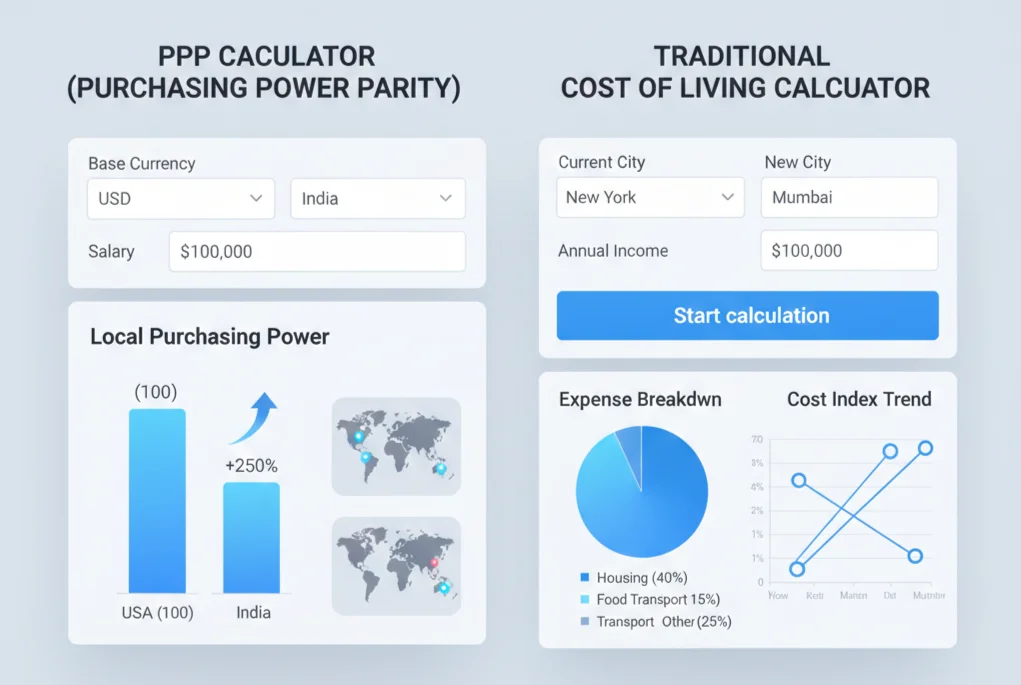
Let’s look at actual calculations from the PPP calculator to see how this works in practice.
Example 1: USA to India
Input: $100,000 USD in USA Output: ₹2,020,000 INR in India
This means to have the same purchasing power as $100,000 in the USA, you would need ₹20.2 lakhs in India. Your money goes much further in India than the exchange rate suggests. At the current exchange rate of about 90 rupees per dollar, $100,000 converts to ₹90 lakhs. But you only need ₹20.2 lakhs to buy the same lifestyle because prices in India are significantly lower.
Example 2: UK to Thailand
Input: £50,000 GBP in UK Output: ฿779,900 THB in Thailand
To have the same purchasing power as £50,000 in the UK, you would need about ฿779,900 in Thailand. This dramatic difference explains why Thailand is popular with remote workers and retirees. Your British salary provides much more buying power in Bangkok than in Birmingham.
Example 3: Germany to Mexico
Input: €35,000 EUR in Germany Output: $474,700 MXN in Mexico
A junior professional earning €35,000 in Germany has equivalent purchasing power to about $474,700 MXN (roughly 475,000 pesos) in Mexico. For someone considering a remote role from a German company while living in Mexico City, this shows how even a modest European salary translates into strong local buying power.
Where PPP Shines
The consistency is the biggest selling point. Because the World Bank uses the same methodology everywhere, comparing Japan to Brazil is just as reliable as comparing France to Poland. You’re not depending on whether enough expats in Krakow happened to log their grocery prices last month.
The data comes from official sources with serious quality controls, which matters when you’re making a decision worth tens of thousands of dollars.
PPP also gives you the big picture without drowning you in details. You don’t need to know that a gym membership costs $15 more in Berlin than in Bangkok. You need to know whether your salary provides a better life in one place versus another. PPP answers that question directly.
Where PPP Falls Short
PPP won’t tell you how much rent costs in your target neighborhood. It operates at the national level, so India’s conversion factor is the same whether you’re moving to Mumbai or a small town in Kerala, even though those are wildly different cost environments. We dig into this limitation in detail in our article on why PPP by city doesn’t work yet.
The data also updates once a year, not in real time. If a country is going through rapid inflation or a currency crisis, the PPP numbers might lag behind reality by several months. And PPP doesn’t break down specific expense categories, so you won’t learn whether housing or healthcare is driving the cost difference.
For personal budgeting, you’ll want to supplement PPP with something more granular. But as a baseline for “is this international opportunity financially worth it?” nothing beats it.
Numbeo: Useful for Budgeting, Risky for Big Decisions
Numbeo takes the opposite approach from PPP. Instead of top-down economic data, it builds its database from the bottom up, collecting real prices from hundreds of thousands of users worldwide.
The platform covers over 12,000 cities with data on everything from the price of a cappuccino to monthly gym memberships to one-bedroom apartment rents. It sets New York City as the baseline (score of 100) and expresses every other city as a percentage. A score of 70 means that city is roughly 30% cheaper than New York.
This granularity is Numbeo’s superpower. If you want to know exactly what a liter of milk costs in Madrid or what internet service runs in Chiang Mai, Numbeo can tell you, and no other tool offers that kind of detail across so many cities. The data updates constantly as users submit new prices, so it tends to reflect current conditions faster than annual surveys.
But here’s the catch. Anyone can submit prices, and there’s no real verification process. In 2017, one person single-handedly skewed the crime statistics for a Swedish city by submitting false data repeatedly. Price data has the same vulnerability. Popular expat destinations like Lisbon or Bali have thousands of data points and tend to be fairly accurate. But for a mid-sized city in Eastern Europe or a second-tier city in Southeast Asia, you might be looking at data from a dozen contributors, half of whom are tourists who paid tourist prices.
Expat bias is a real issue too. Contributors tend to shop at places familiar to foreigners, not at the local markets where residents actually buy food. That pushes the averages higher than what you’d pay once you settle in and learn the local landscape.
My take: Numbeo is excellent for gut-checking specific expenses once you’ve already narrowed down your options. It’s not reliable enough to base a major financial decision on, especially for less popular destinations. Use it as a second opinion, not a first answer.
C2ER: The Gold Standard You’ll Probably Never Use
The Council for Community and Economic Research has published a quarterly Cost of Living Index since 1968. They employ over 300 trained researchers who visit actual stores, follow strict protocols, and price over 60 specific goods and services in more than 300 US cities.
The methodology is airtight. Every researcher follows identical procedures. The data is consistent, comparable, and trusted by employers, government agencies, and economic researchers. If you’re comparing Denver to Seattle or Austin to Chicago, C2ER is the most reliable tool available.
There are two problems. First, C2ER only covers US locations. If your comparison involves any country outside the United States, it’s completely useless. Second, the detailed data requires a paid subscription. Some basic indices are publicly available, but the comprehensive breakdowns that make C2ER valuable sit behind a paywall.
For corporate HR teams managing domestic relocations with a budget for data subscriptions, C2ER is ideal. For an individual comparing international options, it’s a non-starter. I’m mentioning it here because you’ll see C2ER cited in other guides and should understand what it offers, even if it’s not relevant to most international comparisons.
Salary-Adjusted Calculators: Best for Evaluating Job Offers
Some calculators combine cost data with local salary information to answer the most practical question of all: “Is this specific job offer financially better than what I have now?”
These tools start with your current salary and location, then apply cost-of-living ratios alongside local wage data. Consider a marketing manager earning $70,000 in Denver with $1,500 monthly rent. They get an offer in Seattle for $85,000.
A salary-adjusted calculator reveals that Seattle’s overall costs run about 30% higher than Denver. To maintain the same lifestyle, you’d need around $91,000 in Seattle. That $85,000 offer, despite being nominally higher, actually represents a pay cut in real terms.
That’s a powerful insight you won’t get from PPP alone. These calculators also often include profession-specific data, so you can see what marketing managers specifically earn in Seattle, not just general wage averages.
That context makes them excellent tools for salary negotiation. For an international version of this kind of comparison, our salary comparison by country guide walks through the process with real numbers.
The downsides mirror the tool’s strengths. Accuracy depends entirely on the underlying salary and cost datasets. If either is outdated or drawn from a small sample, the recommendation will be wrong. These calculators also focus almost exclusively on US domestic moves. International salary data is much harder to standardize, so most salary-adjusted tools don’t even attempt cross-country comparisons.
Picking the Right Method
No single calculator method is perfect for every situation. The right choice depends on what you’re trying to decide and what information you need. Here’s a quick comparison to help you choose the right tool.
| Method | Best For | Coverage | Data Source | Updates |
|---|---|---|---|---|
| PPP Calculators | International salary comparisons | 180+ countries | World Bank | Annual |
| Numbeo | Specific item prices, city budgeting | 12,000+ cities | Crowdsourced | Ongoing |
| C2ER | US city comparisons, corporate relocation | 300+ US cities | Professional researchers | Quarterly |
| Salary-Adjusted | Evaluating specific job offers | Primarily US | Combined salary + cost data | Varies |
If you’re comparing countries, start with PPP. If you’re comparing US cities, use C2ER or a salary-adjusted tool. If you want to know what specific items cost in a particular city, check Numbeo. And if you’re evaluating a concrete job offer, a salary-adjusted calculator gives the most directly useful answer.
Ready to start with the most reliable method for international comparisons? Our purchasing power parity calculator is free and uses current World Bank data.
How to Cross-Check Your Numbers
Getting a result from one calculator is easy. Knowing whether to trust it is the hard part. Here’s the process I’d recommend.
Run the same comparison through a PPP calculator and through Numbeo. If PPP says your purchasing power roughly doubles in the target country and Numbeo’s cost index shows prices about 50% lower, the tools agree and you can feel confident. If the gap between them is large, dig into what’s causing it.
Next, spot-check the biggest expense categories against actual listings. If you’re looking at Lisbon, open a Portuguese apartment listing site and check real rents in neighborhoods you’d actually live in. Compare those to what Numbeo reports. If the listings show rents 20-30% higher than Numbeo, the crowdsourced data is likely lagging a fast-moving market.
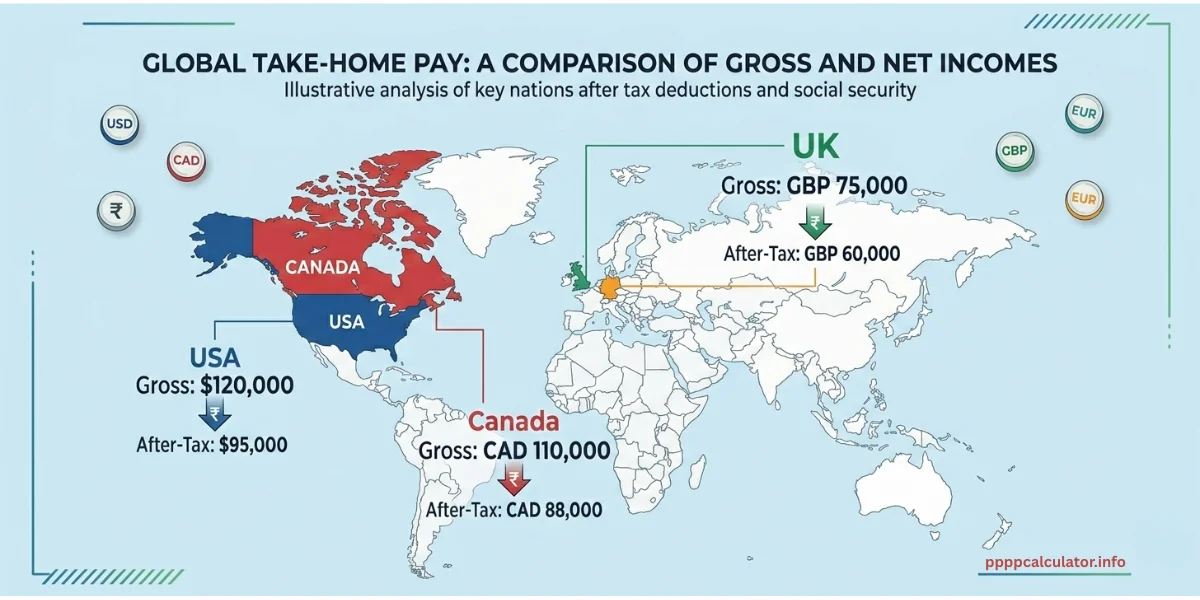
Pay close attention to what no calculator captures. None of the methods above include taxes, visa costs, or healthcare expenses. A country with 40% income tax and free public healthcare looks very different from a country with zero tax and expensive private insurance, but a standard cost of living calculator treats them identically. Layer in tax research separately, especially for international moves where the differences can be massive.
Putting It Together: New York to Lisbon
Say you’re a product manager earning $110,000 in New York, and your company says you can work remotely from Lisbon at the same salary.
PPP tells you Portugal’s conversion factor is 0.535, meaning $110,000 in New York has equivalent purchasing power to roughly €58,900 in Portugal. Keeping your full $110,000 salary while living in Lisbon means your money stretches nearly twice as far as it does in Manhattan.
Numbeo confirms this from the ground up. It shows Lisbon rents at roughly 60% less than New York for a comparable one-bedroom. Groceries run about 45% cheaper. A restaurant dinner for two costs around €35 versus $90 or more in midtown Manhattan.
Local salary data adds the final layer. Product managers in Lisbon typically earn €35,000 to €55,000. Your $110,000 remote salary isn’t just more than the PPP equivalent. It’s double what local companies pay for the same role. That’s a genuinely strong financial position.
No single calculator told the full story. PPP set the baseline. Numbeo filled in the details. Salary data confirmed you’re well above the local market. Together, they painted a picture reliable enough to book the flight.
Making Your Decision
The right cost of living calculator depends on what you’re deciding. For international salary comparisons, PPP gives you the most reliable, consistent baseline. For specific expense planning, Numbeo adds useful detail, at least for well-covered cities. For US relocations, C2ER is the professional standard. And for evaluating a concrete job offer, salary-adjusted tools answer the question most directly.
But no single number should drive a major life decision. Calculators are research tools. They give you an informed starting point, not a guarantee. Pair the numbers with local research, real apartment listings, tax comparisons, and conversations with people who actually live where you’re considering moving. That combination, data plus ground truth, is how you make a decision you won’t regret.
Cost of Living Calculator – FAQ:
No single calculator is perfectly accurate because each method has strengths and limitations. PPP calculators using World Bank data are most reliable for international comparisons. C2ER-based tools are best for US city comparisons. Crowdsourced databases like Numbeo provide detailed item prices but with variable accuracy.
Ans: Exchange rate converters only show how much foreign currency you get for your money. They don’t account for what that currency actually buys. PPP calculators compare purchasing power by looking at what goods and services cost in each location. For example, $100 converts to ₹8,300 at exchange rates, but you might only need ₹2,000 to buy what $100 buys in the US because Indian prices are lower.
Crowdsourced data like Numbeo provides useful insights but requires careful evaluation. It works best for popular cities with many contributors. For smaller cities with few contributors, accuracy decreases. Always cross-reference crowdsourced data with other sources before making major decisions.
Ans: Most basic cost of living calculators focus on expenses and don’t include tax differences. Some salary-adjusted calculators factor in taxes, but many don’t.

Jitender is the founder and lead developer of PPPCalculator.info. He created this free tool to bridge the gap between currency conversion and real purchasing power, helping professionals across 50+ countries make informed salary decisions. He regularly translates complex World Bank and OECD data into practical guides for remote workers and expats.