PPP Calculator | Purchasing Power Parity Salary Converter

Convert your salary from one currency to another using PPP World Bank Certified Data World Bank Certified Data
Enter your current salary in local currency

Compare your salary across 196 countries using the PPP calculator powered by World Bank data. Purchasing power parity shows what your income actually buys in another country, not just what it converts to at today’s exchange rate. Enter your salary above to see the PPP-adjusted equivalent in seconds.

What Your Salary Actually Buys Matters More Than What It Converts

The exchange rate says a €80,000 salary in France converts to roughly $87,000. But can $87,000 in Chicago buy you the same apartment, the same groceries, the same healthcare that €80,000 covers in Lyon? PPP answers that question. It compares the real cost of roughly 3,000 goods and services across economies, using data from the World Bank International Comparison Program, and produces a single number: your salary’s true purchasing power in another country.

Use the free PPP calculator above to compare your salary across 196 countries. Or scroll down for pre-calculated salary tables covering the US, India, UK, Germany, France, Canada, Spain, and Australia.

These figures come from World Bank International Comparison Program conversion factors. Each number shows equivalent purchasing power, not a currency conversion.

US Dollar Salary Equivalents Across Countries

US SalaryIndia (₹)UK (£)Germany (€)France (€)Canada (CAD)Australia (AUD)
$50,000₹10.1 lakhs£34,146€36,405€35,529$56,866AUD 68,460
$75,000₹15.2 lakhs£51,218€54,608€53,293$85,298AUD 102,690
$100,000₹20.2 lakhs£68,291€72,810€71,057$113,731AUD 136,920
$150,000₹30.3 lakhs£102,437€109,215€106,586$170,597AUD 205,380

PPP works for any country pair, not just comparisons with the US. These are some of the most common ones people look up.

Other Popular Salary Comparisons

FromSalaryToPPP Equivalent
UK£40,000AustraliaAUD 80,198
Germany€100,000US$137,343
CanadaCAD 90,000UK£54,041
France€80,000US$112,585

Data source: World Bank International Comparison Program, 2023 conversion factors.

The Spain row is worth a second look. Spain and Germany share a currency, so you might assume €60,000 buys a similar life in both. It doesn’t. Spain’s lower cost of living means €60,000 in Madrid stretches to the equivalent of nearly €75,000 in Berlin. PPP is the only way to see that gap. The purchasing power parity formula explains the math behind these numbers.

Why PPP Number Is Not the Whole Story

PPP compares gross purchasing power at national averages. It skips taxes, city-level price gaps, and quality-of-life differences. All three can shift your result significantly.

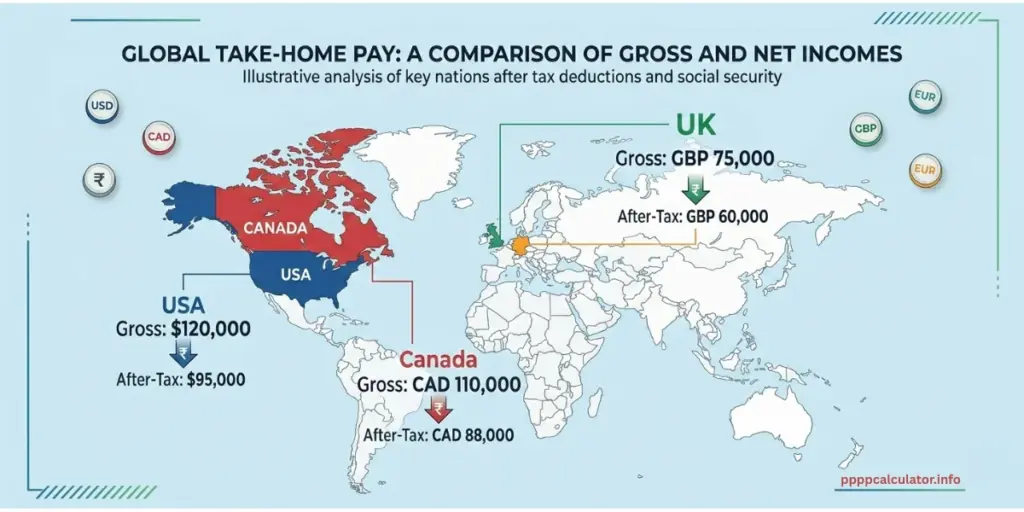
Germany takes 35-45% of a mid-range salary in income tax and social contributions. Dubai takes zero. Two salaries that look identical in the PPP calculator feel very different in your bank account. The after-tax PPP comparison runs the full gross-to-net calculation for India to USA, Canada, UK, and Germany. In one of those corridors, taxes cut the PPP advantage nearly in half.

The calculator also uses national averages. A ¥9.5 million salary means one thing in central Tokyo and something else entirely in Sapporo. Your actual destination might be 30% above or below the country average. Numbeo can fill in that city-level detail, and the PPP by city guide explains how to combine both tools.

Then there’s what no number captures. Healthcare in the US costs more but isn’t necessarily better. Public transit replaces a car entirely in Berlin and barely exists in Houston.

PPP can’t measure whether you’ll need a car, how long your commute is, or whether your kids’ school is free. It’s the best starting point for a salary comparison, not the final answer. For more on where PPP works and where it misleads, read the complete guide to purchasing power parity.

How Purchasing Power Parity Compares Salaries

Purchasing power parity is an economic measure that compares the real value of money across countries. The World Bank measures prices of roughly 3,000 items across participating economies and produces a conversion factor per country. That factor is what the PPP calculator uses to translate a salary into equivalent buying power rather than equivalent currency.

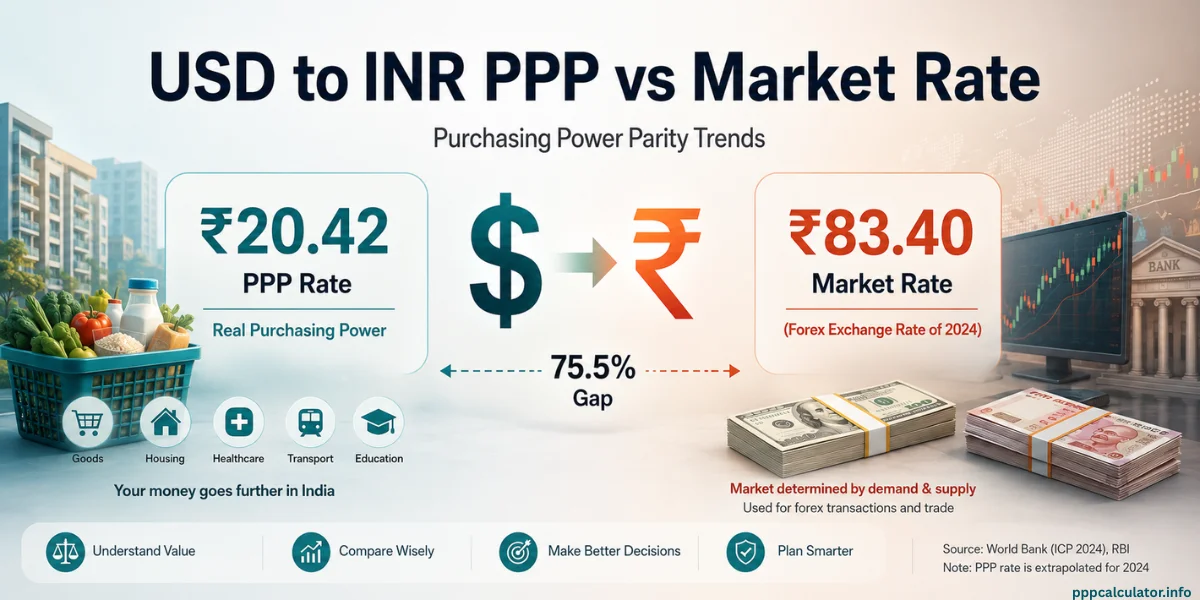
Exchange rates reflect what traders pay for a currency on financial markets. PPP reflects what people pay for rent, food, transport, and healthcare in their daily lives. The gap between these two measures can be enormous.

Convert $100,000 to Indian rupees at market rates and you get roughly ₹85 lakhs. The PPP equivalent is ₹20.2 lakhs, because everyday costs in India are a fraction of US prices. The difference between these approaches matters for every salary decision that crosses a border. The guide on PPP vs exchange rates breaks down when each method applies.

What People Use a PPP Calculator For

People compare salaries across countries using PPP to evaluate job offers, negotiate remote pay, and set international compensation.

Say a company in San Francisco offers you $120,000 and a company in London offers £82,000. Exchange rate math says the US offer wins. PPP says those two salaries buy almost exactly the same life. The London offer isn’t worse. It’s priced in a different economy. That reframes the entire decision.

Remote workers use the PPP calculator the other way. If you earn $120,000 in New York but move to Lisbon, the PPP equivalent is about €64,251. Even after a 15% pay cut, you come out ahead. The remote salary adjustment guide shows how to bring those numbers into an actual negotiation.

HR teams use PPP to set compensation across offices without guessing. GitLab and Buffer publicly built their pay frameworks on geographic adjustment factors similar to PPP. The salary converter by country compares how different tools handle international salary benchmarking.

Country-Specific Salary Comparisons

Every country pair has its own tax rules, visa costs, and city-level price gaps that change the story PPP tells. The country comparison guides combine the PPP calculator results with the details that affect your decision.

PPP Calculator India vs USA: H-1B economics, real salary data for software engineers and nurses, and when the move makes financial sense.

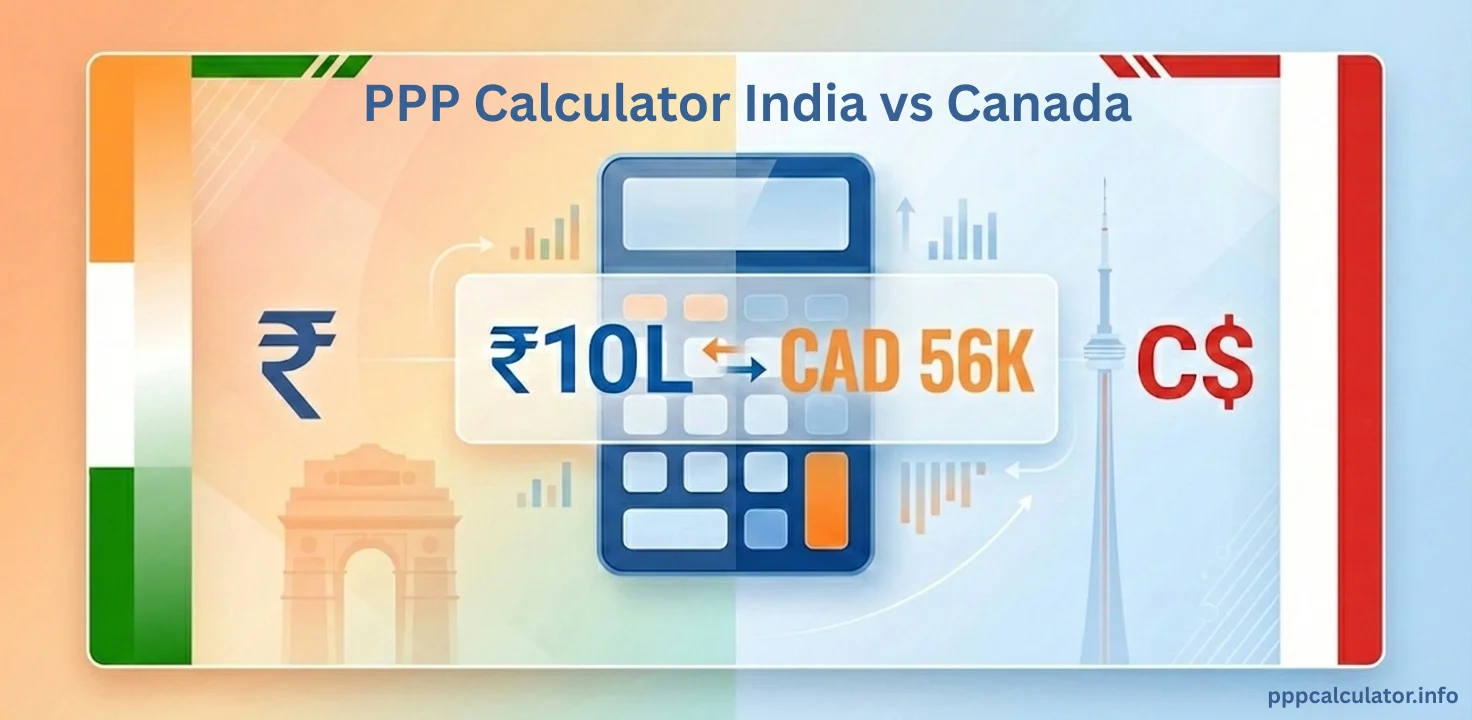
PPP Calculator India vs Canada: Express Entry, provincial tax differences, and what permanent residency changes financially.

PPP Calculator India vs Dubai: Why tax-free income is not as simple as it sounds once housing takes 30-40% of your salary.

PPP Calculator India vs Other Countries: Singapore, Japan, Qatar, Saudi Arabia, South Korea, and more.

Understand the PPP Method

The PPP concepts hub covers the theory behind the calculator. What is Purchasing Power Parity? goes beyond the textbook definition into where PPP actually misleads. How to Use a PPP Calculator walks through real comparisons step by step. The purchasing power parity formula explains why the same salary produces different PPP results depending on which conversion factors you use.

And The Big Mac Index shows how one burger illustrates what the full methodology measures.

The blog covers the practical side. PPP Salary After Tax is the calculation no other source publishes: complete gross-to-net PPP comparison for four India corridors. Cost of Living Calculator tests where PPP and Numbeo agree and where they diverge. PPP Calculator by City explains why city-level PPP doesn’t exist in World Bank data yet and what actually works instead.

Frequently Asked Questions

What is a PPP calculator and how does it compare salaries?

A PPP calculator compares the real buying power of a salary across countries using World Bank price data. It shows what you’d need to earn somewhere else to afford the same life you have now, which is different from a simple currency conversion.

Why do PPP results differ so much from exchange rate conversions?

Exchange rates reflect what traders pay for a currency. PPP reflects what people pay for rent, food, and daily necessities. $100,000 converts to roughly ₹85 lakhs at market rates, but the PPP equivalent is ₹20.2 lakhs because everyday goods in India cost far less than in the US.

Is PPP accurate enough for salary negotiations?

World Bank PPP data is the global standard for cross-country price comparisons. It gives you the most reliable starting point available. But it uses national averages and ignores taxes, so pair it with city-level data from Numbeo and tax calculations from SalaryAfterTax.com for the complete picture.

Does the PPP calculator include taxes?

No. PPP compares gross purchasing power only. Tax differences between countries can be large enough to reverse the result entirely.

Can HR teams use PPP for international compensation?

Yes. GitLab and Buffer publicly built pay frameworks on geographic adjustment factors similar to PPP. World Bank data gives compensation teams a transparent, neutral baseline, and most layer local market data on top./*

About PPP Calculator

PPPCalculator.info is a free purchasing power parity salary comparison tool covering 196 countries and territories. It uses World Bank International Comparison Program conversion factors, drawn from standardized price surveys of roughly 3,000 goods and services. The site is maintained by Jitender.

Every comparison on this site is calculated from official World Bank conversion factors updated annually. No crowdsourced data, no estimates, no signup required.

PPPCalculator.info differs from other salary comparison tools in a specific way. Numbeo and Expatistan rely on crowdsourced city-level price reports. SalaryAfterTax.com shows take-home pay without purchasing power context. This calculator shows what your salary actually buys in another country using World Bank methodology. The two tools work well together: PPPCalculator.info for the purchasing power baseline, SalaryAfterTax.com for the tax step.

Learn more about the World Bank International Comparison Program methodology.

Compare your salary now

Share via
Copy link