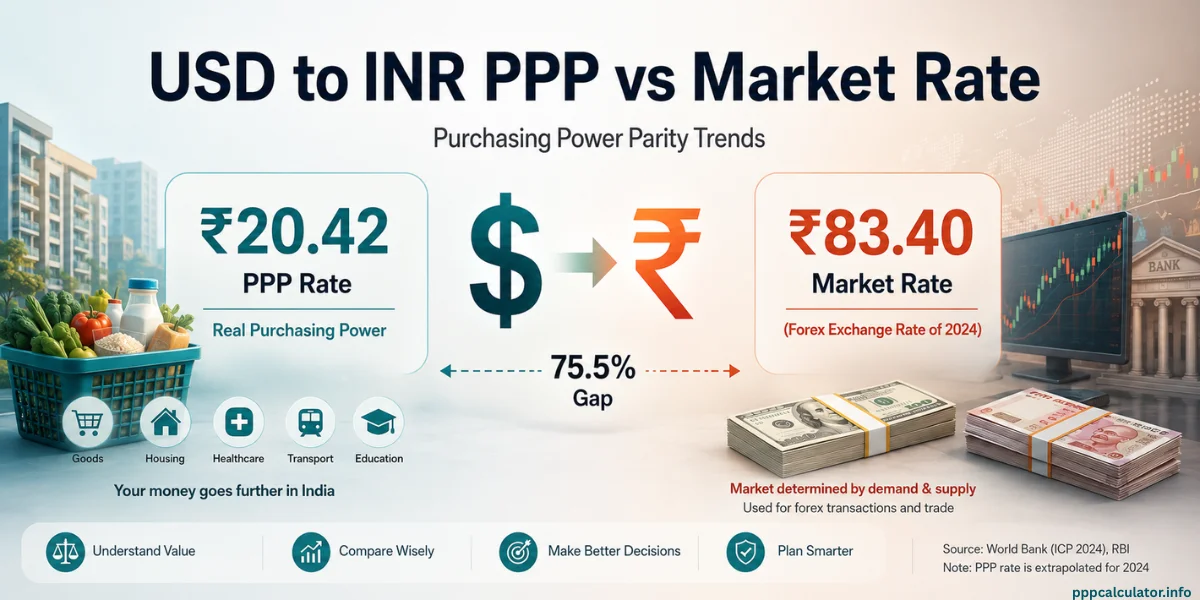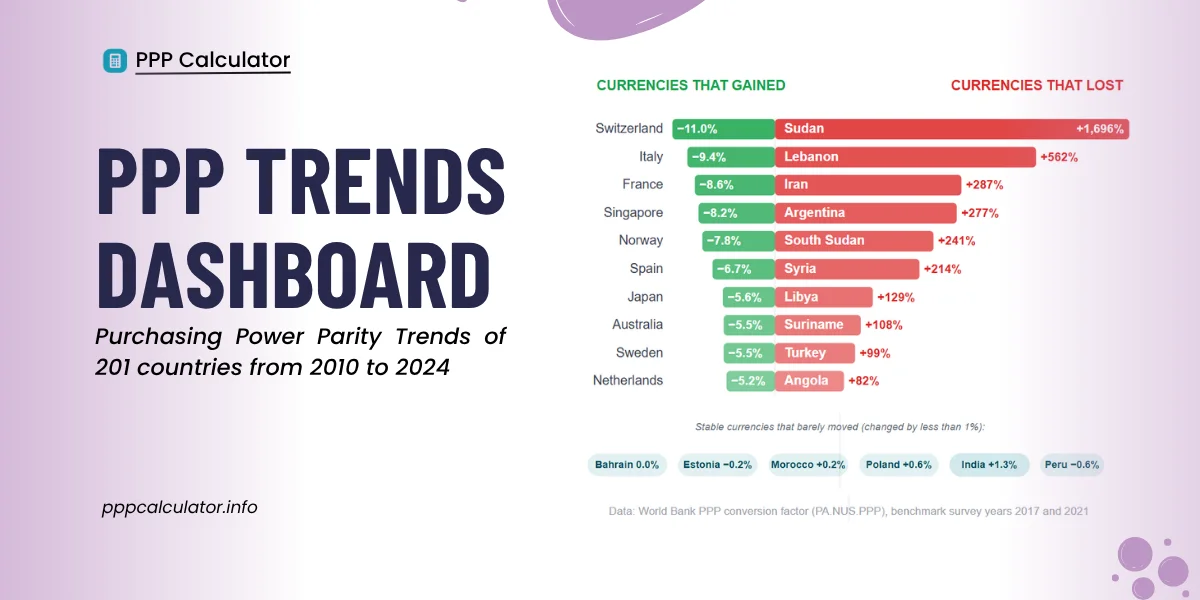
The financial logic behind remote work abroad is simple. Earn in a strong currency, spend in a cheaper one, and keep the difference. But “cheaper” is not a feeling. It’s a number.
Using 2024 World Bank PPP conversion factors, this article shows exactly how far a $5,000/month income stretches in the destinations that dominate every serious 2026 nomad ranking, plus what the rankings leave out.
You can verify any salary pair through the below given PPP calculator.
What “Best Purchasing Power” Means for Digital Nomads
A country has strong purchasing power for a remote worker when the cost of living a good life there is substantially lower than in the USA or Western Europe, not just in headline rent figures, but in groceries, healthcare, transport, and the kind of daily spending that compounds into savings or financial freedom over a year.
The table below uses 2024 World Bank PPP conversion factors and approximate exchange rates to show how much a USD earner actually needs to spend each month to maintain the equivalent of a $5,000/month US lifestyle. Every figure in this article comes from that same dataset, published by the World Bank ICP programme.
Top Purchasing Power Countries
How Best PPP Countries Ranking Was Built
Each country in this article is scored across six criteria drawn from the Immigrant Invest Digital Nomad Visa Index 2026, CitizenRemote, Northman and Sterling, and Realting rankings, weighted to reflect what pppcalculator.info measures.
- PPP purchasing power carries 30% of the total score because it is the site’s primary data source and the foundation of any honest comparison.
- Tax treatment for remote workers carries 20% because you live on after-tax income, not gross.
- Visa accessibility and duration carry 20% because a destination you cannot stay in legally is not a base.
- City-level rent affordability carries 15% because the World Bank PPP factor is a national average, not what you actually pay in Tbilisi or Chiang Mai.
- Internet and infrastructure carry 10%, covering connectivity, coworking, English proficiency, safety, and healthcare.
- Long-term residency pathway carries the final 5%.
Every criterion is scored 1-10. The table below shows the full working.
| Country | PPP /10 (30%) | Tax /10 (20%) | Visa /10 (20%) | Rent /10 (15%) | Infra /10 (10%) | LT Res /10 (5%) | Total /10 |
|---|---|---|---|---|---|---|---|
| 1Georgia | 10 | 9 | 8 | 10 | 6 | 3 | 8.65 |
| 2Malaysia | 10 | 7 | 8 | 9 | 8 | 4 | 8.35 |
| 3Thailand | 10 | 8 | 6 | 9 | 7 | 3 | 8.00 |
| 4Spain | 7 | 9 | 9 | 5 | 9 | 9 | 7.80 |
| 5Croatia | 9 | 8 | 7 | 8 | 7 | 3 | 7.75 |
| 6Portugal | 8 | 5 | 9 | 6 | 8 | 9 | 7.35 |
| 7Indonesia | 10 | 8 | 4 | 8 | 6 | 2 | 7.30 |
| 8Estonia | 7 | 6 | 7 | 6 | 10 | 4 | 6.80 |
| 9Mexico | 7 | 8 | 6 | 7 | 6 | 5 | 6.80 |
1. Georgia: Best Overall Score for Digital Nomads

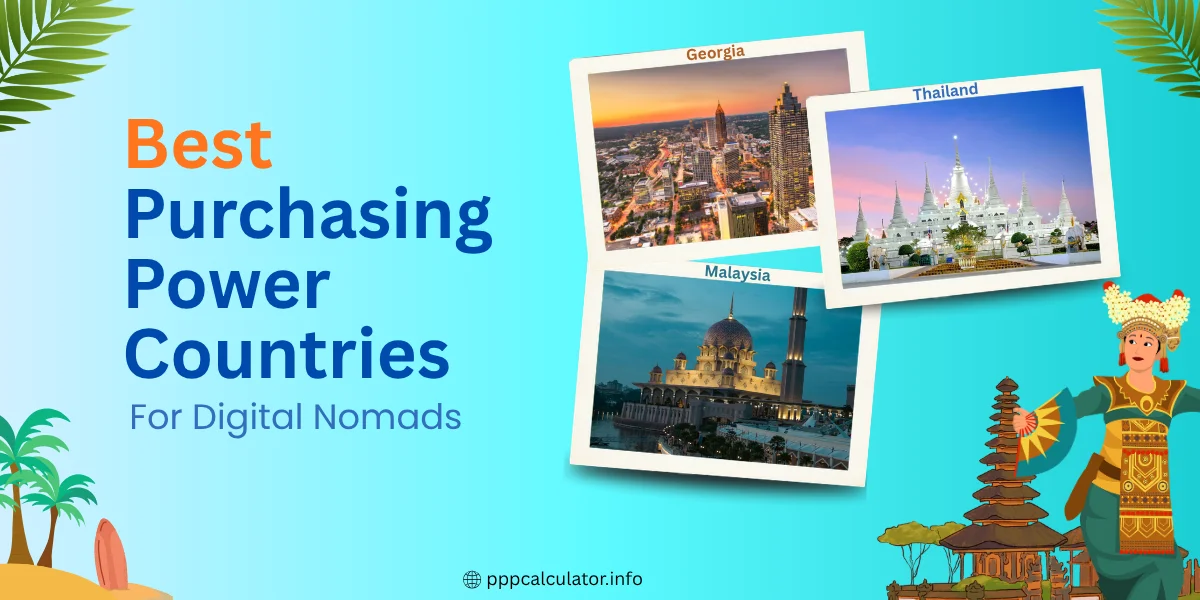
Georgia’s PPP factor of 0.889 GEL per international dollar means a remote worker needs roughly ₾4,445/month to match US $5,000 of purchasing power, approximately $1,640 at current exchange rates, a 67% cost reduction.
Combined with the 1% tax rate available to freelancers who register as Individual Entrepreneurs under Small Business Status. Georgia offers a combination no European country can match on pure financial terms. You become a Georgian tax resident after 183 days in the country, at which point the 1% rate applies to turnover up to approximately 500,000 GEL annually.
Tbilisi is the nomad base, primarily neighborhoods like Vera and Vake. Rents rose significantly between 2022 and 2024 following a large influx of Russian and Ukrainian remote workers, then stabilized.
A decent one-bedroom in a central area now runs $500–900/month. Internet is fast, coworking options are numerous, and visa-free entry allows most nationalities to stay up to 365 days.
Visa snapshot: Visa-free 365 days for 95+ nationalities, Individual Entrepreneur registration available, 1% tax on turnover under Small Business Status.
2. Malaysia: Asia’s Infrastructure-First PPP Destination
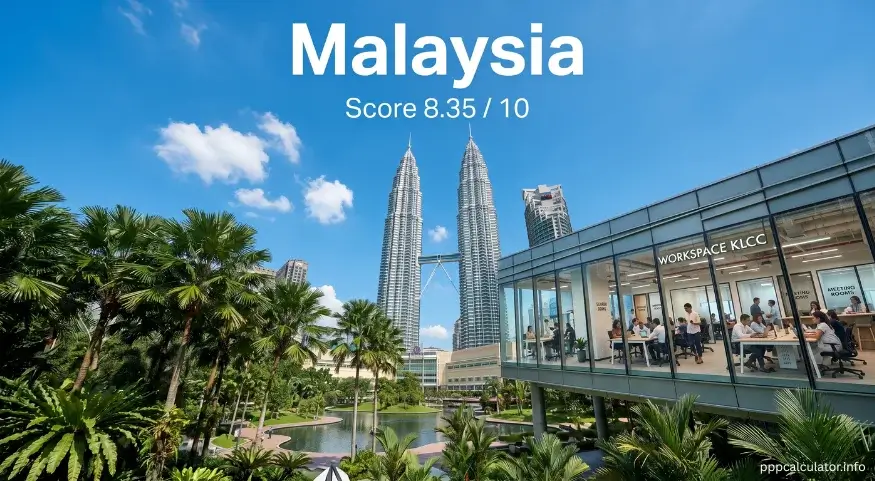
Malaysia’s PPP factor is 1.401 MYR per international dollar. A remote worker needs about RM7,005/month to match US $5,000 of purchasing power, which converts to roughly $1,568, comparable to Thailand, but in a country with better infrastructure, English widely spoken in business contexts, private hospitals meeting international standards, and an urban environment that suits professionals with families.
Kuala Lumpur is the primary nomad base, specifically areas like Mont Kiara and Bangsar that have dense international communities, reliable coworking infrastructure, and a range of accommodation from budget studios to serviced apartments. A one-bedroom in Mont Kiara runs RM2,500–4,500/month ($560–1,005).
Visa snapshot: DE Rantau Nomad Pass, 12 months (renewable to 24), income ~$2,000/month, relatively accessible threshold.
3. Thailand: Highest Absolute PPP Advantage in Asia

Thailand’s PPP factor is 10.492 THB per international dollar. To match $5,000/month of US purchasing power in Thailand, a resident needs about ฿52,460 per month, which at current exchange rates converts to roughly $1,565. That’s the lowest USD-equivalent monthly cost of any widely recommended nomad destination.
Chiang Mai has been the benchmark for over a decade, and the cost structure still holds in 2026. A good one-bedroom in a central but not premium area runs ฿8,000–15,000/month ($240–450).
Bangkok has drifted upward, particularly in Sukhumvit and Silom, where a comparable apartment runs ฿18,000–30,000/month ($540–895). Phuket sits between the two, with beach proximity pushing rents higher than either city by 15–25%.
Visa snapshot: The visa picture requires attention.
- Thailand’s Long-Term Resident (LTR) Visa, launched in 2022, targets high-income professionals with a minimum income of $80,000/year and offers 10-year residency.
- Below that threshold, the most common practical option in 2026 is the Destination Thailand Visa (DTV), which requires a bank balance of 500,000 THB over the last three months and allows a 180-day stay extendable once.
- Border run culture, which sustained nomads for years, became significantly less predictable after enforcement tightened in 2024.
4. Spain: Best PPP Value in Western Europe
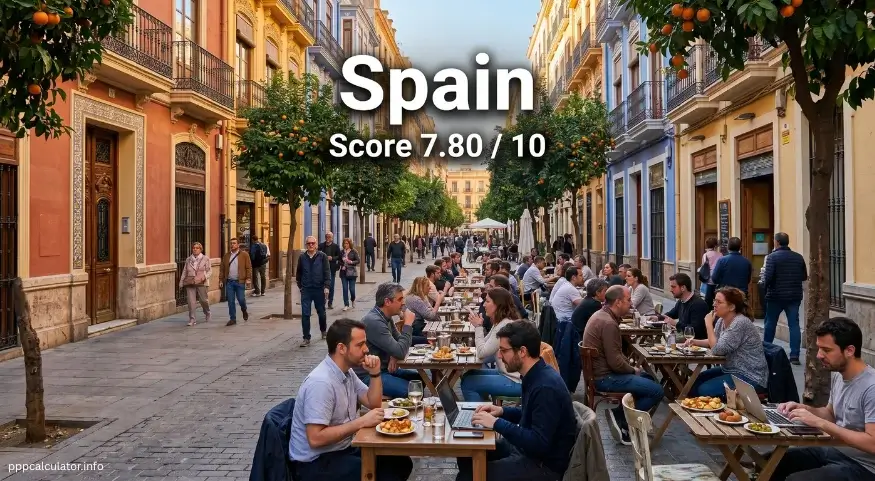
Spain ties Portugal at the top of every ranking, and the PPP data gives a clear reason why. Spain’s World Bank factor is 0.562 versus Germany’s 0.701 and France’s 0.681.
To match $5,000/month of US purchasing power in Spain, a remote worker needs about €2,360/month, or roughly $2,575 at current exchange rates. That’s the eurozone purchasing power anomaly in practice.
The Beckham Law (formally the special expat tax regime) can cap income tax at 24% for eligible professionals for up to six years, a meaningful benefit for higher earners that Portugal’s equivalent no longer offers to most new arrivals.
A one-bedroom apartment in Valencia runs €800–1,100/month. Las Palmas, on Gran Canaria, adds warm weather year-round and regularly appears in lists of Europe’s top nomad cities at costs 30–40% below Lisbon.
Visa snapshot: Digital Nomad Visa under Startup Act, up to 1 year, renewable to 5 years, minimum monthly income requirement ~€2,160/month with 80% of that income coming from outside Spain.
5. Croatia: Mediterranean Lifestyle at Central European Costs
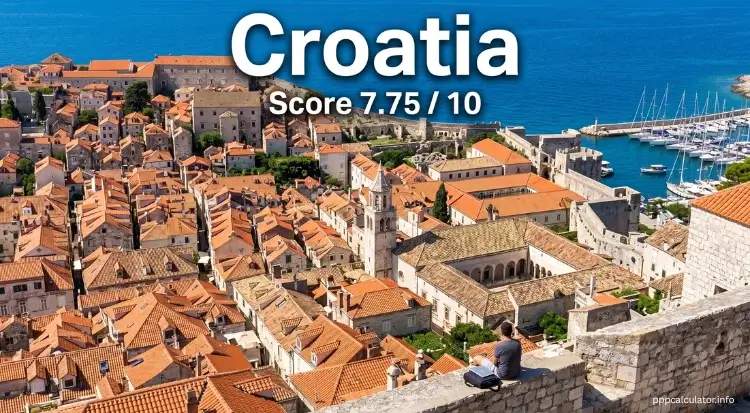
Croatia’s PPP factor of 0.448, the lowest of any European destination in this article, means that to match $5,000/month of US purchasing power, a resident needs just €2,058/month, or about $2,244 at current exchange rates. That’s a 55% cost reduction and positions Croatia as the best pure PPP value in Europe for USD earners.
Split, Zadar, and Dubrovnik attract the most nomad attention. Split offers the best balance of city infrastructure, coastal access, and cost. Dubrovnik is beautiful but tourist pricing applies year-round in the historic centre. Move to the surrounding area for normal costs.
Zagreb, the capital, is the least scenic but the most practical for anyone prioritising connectivity and services over lifestyle scenery.
The Croatian nomad community is smaller than Portugal’s or Spain’s, which matters if community is a deciding factor. But the coworking infrastructure in Zagreb and Split has expanded considerably since 2022.
Visa snapshot: The Digital Nomad Visa allows stays of up to 18 months (renewable for another 18), with an income requirement of approximately €2,300/month. The combination of 36 months of legal stay, Adriatic coastline, and costs well below Portugal’s makes it an underrated choice in most rankings.
6. Portugal: The European Anchor for Digital Nomads

Portugal appears in every major 2026 nomad ranking without exception. The D8 Digital Nomad Visa, a minimum income requirement of €3,680/month as of 2026, and a stable path toward EU residency make it the clearest legal choice for remote workers who want a European base.
The PPP case is solid. To match the purchasing power of $5,000/month in the United States, a resident in Portugal needs roughly €2,170 per month, about $2,370 at current exchange rates. A remote worker earning $5,000/month is effectively living on 47% of their income and keeping the rest.
Lisbon and Porto dominate nomad conversation, but both have become meaningfully more expensive since 2020. A one-bedroom apartment in central Lisbon now runs €1,400–1,900/month. Porto is 20–25% cheaper. Madeira has an established nomad village in Ponta do Sol and costs roughly €1,000–1,400/month for a decent one-bedroom outside the peak season rush.
The NHR tax regime, which gave qualifying professionals a 20% flat tax rate, closed to new applicants in January 2025 and was replaced by the IFICI scheme targeting narrower professional categories.
Standard remote workers now face Portugal’s progressive income tax scale, which runs from 14.5% to 48%. That significantly changes the after-tax math for higher earners. The PPP advantage remains real; the tax picture is no longer the draw it once was.
Visa snapshot: D8, up to 1 year initially, renewable to 5, income requirement €3,680/month, path to permanent residency after 5 years.
7. Indonesia (Bali): The Icon That Still Delivers
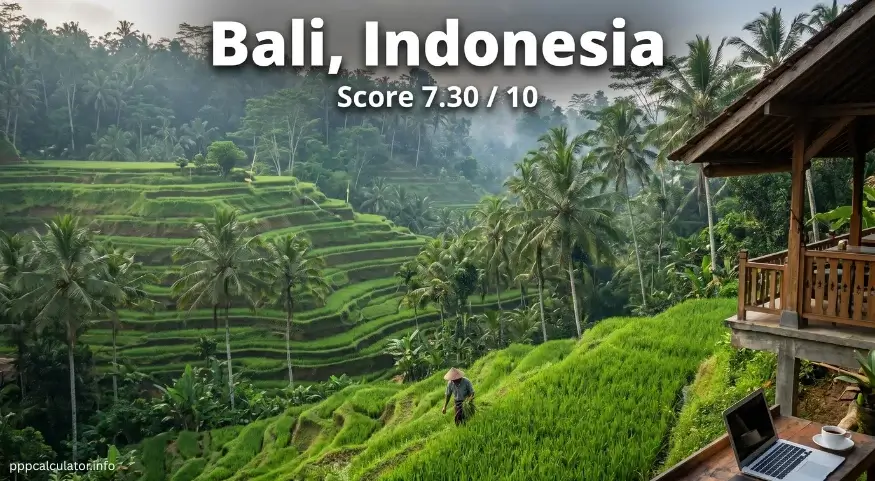
Bali’s PPP factor as part of Indonesia (4747.91 IDR per international dollar) converts to roughly $1,503/month of US-equivalent spending, the lowest USD equivalent in this article.
The purchasing power case is strong on paper, but Bali functions differently from a national average. The areas where nomads actually live are considerably more expensive than rural Indonesia.
For the actual experience of Bali as a nomad base in 2026, budget $1,800–2,500/month as a realistic total cost in Canggu, still meaningfully cheaper than Western cities, but not the $800/month that older guides suggested.
Visa snapshot:
- Indonesia introduced the Second Home Visa in 2022 (5 or 10 years, requiring $130,000 deposited in an Indonesian bank or equivalent fixed asset) and has discussed a dedicated nomad visa.
- Most nomads useB211A (60 days, extendable to 60 more), social-cultural visa (180 days). No simple long-term nomad visa as of April 2026.
8. Estonia: Europe’s Digital-First Nomad Base
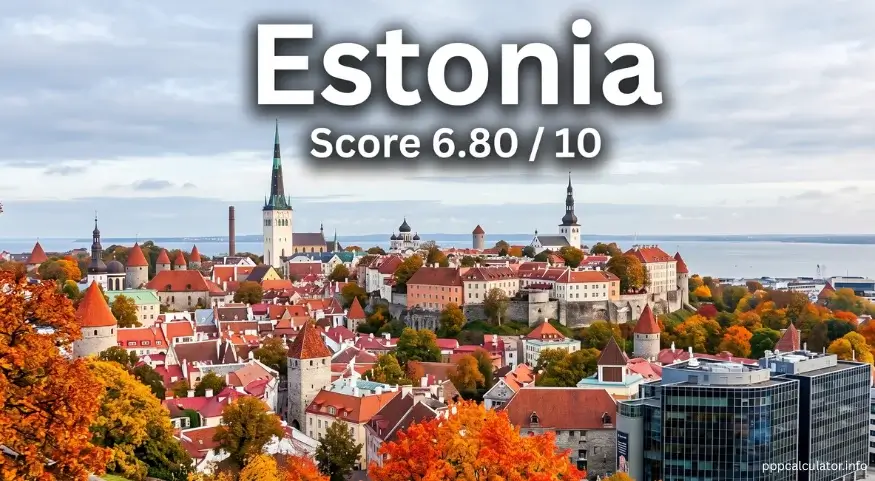
Estonia appears in five of the eight sources reviewed for this article, more than Croatia, Malaysia, or Georgia. The reason is not cost. Estonia is not cheap by Southeast Asian standards, but infrastructure and legal clarity that most destinations cannot match.
Estonia’s PPP factor is 0.576. To match $5,000/month of US purchasing power there, you need roughly €2,655/month, or about $2,895 at current exchange rates. That’s a 42% cost reduction compared to the US, broadly similar to Spain, but with a different value proposition.
Tallinn has fast, ubiquitous internet including in rural areas, digital government services that mean almost everything from signing contracts to registering a company can be done online, and an e-Residency program that lets you operate an EU-registered company from anywhere.
Tartu, Estonia’s second city, is considerably cheaper than Tallinn and has a strong university-driven culture. For nomads willing to trade cosmopolitan density for lower costs and a quieter pace, it’s a genuine option.
Visa snapshot: The Digital Nomad Visa requires proof of a minimum gross monthly income of €4,500/month gross from abroad, valid for 12 months (not renewable in-country) and generally not renewable in-country. The country itself functions like a startup, with digital infrastructure that genuinely earns that description.
9. Mexico: North America’s Time-Zone Play
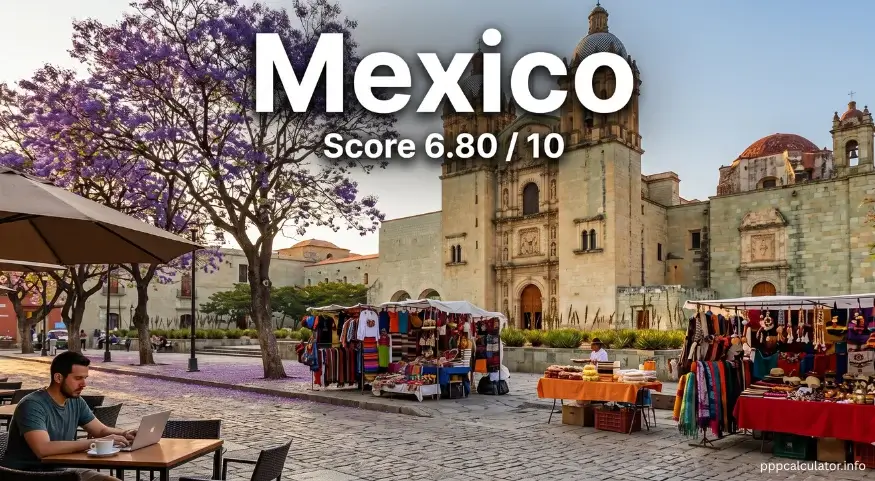
Mexico’s PPP factor is 9.917 MXN per international dollar. To match $5,000/month of US purchasing power, you need about ₱49,585 MXN, or roughly $2,883 at current exchange rates, a 42% cost reduction. What Mexico offers that Thailand or Croatia can’t is time-zone alignment.
A developer or consultant in Oaxaca City or Guadalajara working for US clients sits in Central or Mountain Time. Meetings happen at normal hours. Slack messages get answered same-day. For remote workers whose income depends on US-based clients or teams, that practical advantage outweighs a better PPP number six time zones away.
Mexico doesn’t have a dedicated digital nomad visa. The tourist FMM permit allows 180-day stays renewable by border crossing, which remains the most common approach. A formal nomad visa framework is in development but hadn’t launched as of April 2026.
Mexico City’s Roma Norte and Condesa colonias have been heavily gentrified by the nomad influx since 2021, with rents rising 30–50% in those specific areas. Guadalajara, Oaxaca City, San Miguel de Allende, and Mérida offer better value while retaining reliable internet and established nomad communities.
Visa snapshot: FMM tourist permit, 180 days, renewable by border exit, no formal nomad visa as of April 2026.
How to Use the PPP Number Before Choosing a Destination
PPP tells you the country-level cost advantage. It doesn’t choose a destination for you. Three additional checks matter before committing to any base.
First, identify your city. The PPP figure reflects a national average. Bangkok and Chiang Mai are both Thailand. Lisbon and a small town in the Alentejo are both Portugal. The gap between city and national average can be 40–60% in either direction. Once you have a country shortlist, research rents in the specific city before treating the PPP number as a budget.
Second, check the after-tax picture for your income structure. Georgia’s 1% rate and Spain’s Beckham Law serve very different income levels. Portugal’s NHR closure in January 2025 changed the calculation for professionals who were planning around it. Tax residency rules, triggering in most countries at 183 days, can change your effective rate dramatically. The PPP number is a gross comparison, you live on net.
Third, factor in visa sustainability. Croatia’s 36-month maximum stay, Georgia’s 365-day visa-free entry, and Spain’s 5-year renewable visa all suit different timelines. A destination where you can’t stay legally long-term isn’t a base. It’s a holiday.
FAQ – Best Purchasing Power Countries
Indonesia, Thailand, Malaysia, Georgia, and Colombia offer the greatest purchasing power advantages for USD earners. Your monthly spend to maintain a US lifestyle drops by 65–70% in those countries.
The World Bank PPP figure covers the whole country, not specific cities or regions. PPP tells you which country to shortlist; your city research tells you what you’ll actually spend.
Yes, one stable base usually wins financially. You qualify for lower long-term rental rates, avoid repeated visa fees and travel costs, and can establish tax residency in a low-rate jurisdiction like Georgia.
Check another important and useful article – Purchasing Power Parity in Digital Products: A Global View

Jitender is the founder and lead developer of PPPCalculator.info. He created this free tool to bridge the gap between currency conversion and real purchasing power, helping professionals across 50+ countries make informed salary decisions. He regularly translates complex World Bank and OECD data into practical guides for remote workers and expats.