
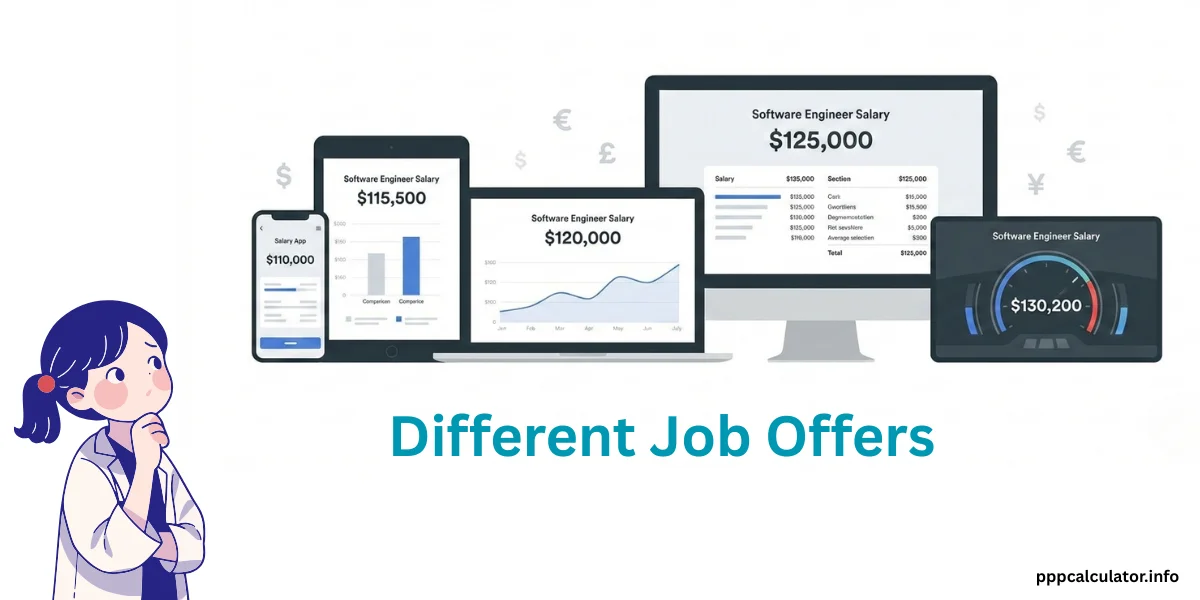
A data scientist in Berlin gets a LinkedIn message offering $135,000 in Chicago. She opens five different tools to evaluate the offer.
Glassdoor says the average data scientist in Chicago earns $125,000. Numbeo says Berlin is 35% cheaper than Chicago. Expatistan tells her she needs $142,000 in Chicago to match her Berlin lifestyle. A PPP salary converter says her current salary of €75,000 equals $102,900 in US purchasing power. The recruiter’s offer is $135,000. So is it good?
Every tool gives a different answer because each one measures something different. That is the core problem with salary comparison between countries. You are not short on tools. You are short on understanding which tool answers which question.
This guide breaks down the five most common methods people use for salary conversion by country, shows you where each one fails, and gives you a practical checklist to combine them into one reliable answer.
Key Takeaways
- Different salary comparison tools measure different things, which is why they give different results for the same country pair. Knowing which tool answers which question is more valuable than trusting any single number.
- Different tools show what employers pay for specific roles in specific locations, but they cannot tell you whether that pay maintains your current lifestyle.
- Cost-of-living indexes from Numbeo and Expatistan are useful for city-level comparisons, but their data is crowdsourced and can be unreliable for smaller cities or developing countries.
- PPP conversion factors from the World Bank offer the most methodologically sound basis for equivalent salary calculation, but they work at the country level and miss taxes, benefits, and city-specific costs.
- The most accurate salary comparison combines PPP as the starting layer, Glassdoor for role-specific market rates, and local tax research for take-home pay.
Five Ways People Compare Salaries Across Countries
When someone searches for a salary converter by country, they usually land on one of five types of tools. Each serves a real purpose, but none tells the complete story on its own.
1. Role-Specific Salary Databases
Platforms like Glassdoor, PayScale, and Levels.fyi collect salary data from employees who self-report their compensation. You search by job title and location, and the tool shows you what people in that role typically earn in that city or country. These platforms answer the question: “What does the local job market pay for someone like me?”
This is useful when you want to know the going rate for your role. If you are a product manager considering a move to Amsterdam, Glassdoor can tell you that product managers in Amsterdam earn between €55,000 and €85,000. That is valuable market intelligence.
But these platforms do not answer a different, equally important question: “Will that salary give me the same quality of life I have now?” A product manager earning €70,000 in Amsterdam and one earning $95,000 in Boston might look very different on paper, but their day-to-day purchasing power could be surprisingly similar.
2. Cost-of-Living Indexes
Numbeo, Expatistan, and similar sites calculate cost-of-living indexes by collecting prices for specific items (rent, groceries, restaurant meals, transport) across cities. They typically set one city as a baseline (often New York at 100) and score every other city relative to it.
These tools answer the question: “How much more or less expensive is City B compared to City A?” If Numbeo says Lisbon’s cost of living is 52% lower than New York, you can estimate that your dollar stretches roughly twice as far there.
The strength of these tools is city-level granularity. They can compare Porto versus Prague, something national-level data cannot do. The weakness is that the data comes from user submissions with no verification.
For popular cities like London or Tokyo, thousands of data points make the index reliable. For a mid-sized city in Colombia or Romania, the sample might be 30 people, making the result unpredictable.
3. Government and Institutional Wage Data
Organizations like the OECD, the ILO, and national labor departments publish official wage statistics. The OECD tracks average annual wages across its 38 member countries. The ILO covers broader global data. These are not tools you interact with. They are datasets used by researchers, policymakers, and compensation consultants.
This data answers the question: “What is the national average wage for workers in Country X?” It is excellent for understanding macro-level salary landscapes. But it does not help you compare your specific role, your experience level, or your spending patterns against another country. An average includes everyone from baristas to bank executives.
4. Enterprise Compensation Surveys
Mercer, Willis Towers Watson, Korn Ferry, and Radford run large-scale compensation surveys used by corporations to set global salary bands. These surveys collect verified data directly from employers, broken down by job level, function, and region. They are the gold standard for accuracy.
The catch is access. These surveys cost thousands of dollars per year and are built for HR teams at large companies. Individual job seekers and freelancers cannot typically access this data. If your company uses one of these platforms to set your salary, you are benefiting from it indirectly, but you cannot use it yourself to evaluate a competing offer.
5. PPP-Based Salary Converters
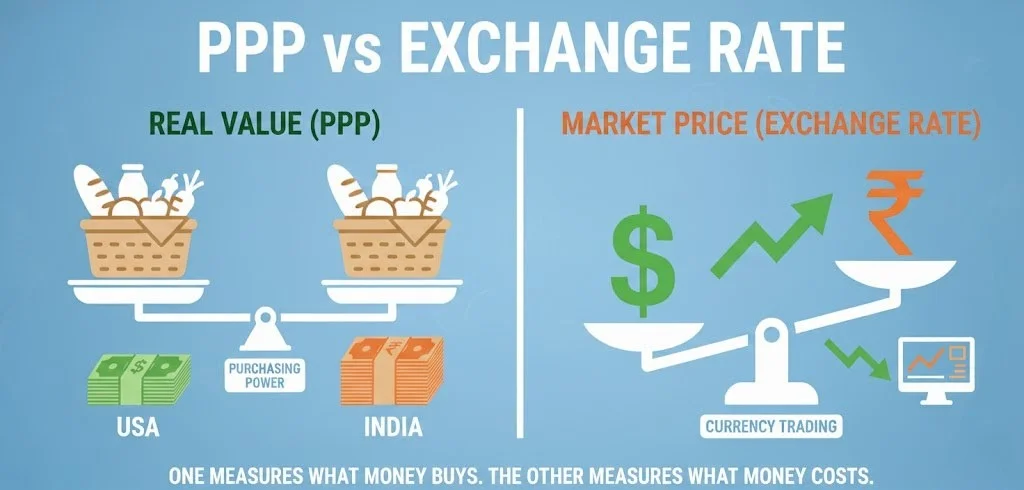
PPP converters use World Bank purchasing power parity data to show you the equivalent salary you would need in another country to maintain the same standard of living. Unlike cost-of-living indexes, PPP factors come from the International Comparison Program, which surveys prices for roughly 3,000 goods and services across 176 countries using standardized methodology.
PPP converters answer the question: “How much would I need to earn in Country B to buy the same basket of goods and services I can afford in Country A?” This is the closest thing to a true equivalent salary calculator, because it is built on verified price data collected at national scale.
The limitation is that PPP operates at the country level. It cannot distinguish between Mumbai and Pune, or between Berlin and rural Bavaria. It also does not factor in tax rates or employer-provided benefits, both of which can dramatically change your actual take-home lifestyle.
Hidden Costs No Salary Converter Shows You

Salary tools compare numbers. But your actual financial life after an international move depends heavily on factors that sit outside every calculator, index, and conversion tool. These five costs catch people off guard most often.
Taxes and Mandatory Deductions
A gross salary of $100,000 leaves you with very different amounts depending on where you earn it. In Switzerland, your effective tax rate might be 20-22%. In Belgium, it could exceed 45%. In the UAE, it is zero. No salary converter factors this in automatically, and the differences are massive.
A €75,000 offer in Munich and a €65,000 offer in Lisbon can produce nearly identical take-home pay once you account for Germany’s higher income tax brackets and solidarity surcharge versus Portugal’s NHR (Non-Habitual Resident) tax regime that caps certain income at 20% for qualifying expats.
Mandatory social security contributions add another layer. In France, employer and employee contributions combined can add over 60% on top of net salary. In Singapore, CPF contributions are capped and partially returned to you as retirement savings.
These are not optional deductions. They come off your paycheck before you see a cent, and they vary wildly across countries.
Benefits That Replace Cash Spending
In countries with strong public systems, your salary goes further than the number suggests because you do not pay for things that would cost you thousands elsewhere. A €55,000 salary in Germany includes statutory health insurance, six weeks of paid sick leave, employer-funded pension contributions, and a minimum of 20 paid vacation days (most employers offer 25-30).
None of these appear in the salary figure, but they eliminate expenses that could cost $15,000-$25,000 per year out of pocket in a country like the USA.
The reverse is also true. A $130,000 salary in the US looks high, but if your employer’s health plan costs you $500/month in premiums with a $3,000 deductible, and you are saving 6% into a 401(k) to capture the company match, your effective disposable income drops significantly.
When comparing international offers, the salary number is often the least honest part of the total compensation picture.
One-Time and Ongoing Relocation Costs
Moving internationally comes with costs that no annual salary comparison captures. Visa application fees, immigration lawyer costs, security deposits on housing (often 2-3 months rent upfront in countries like Germany or Japan), shipping personal belongings, and temporary accommodation while you find a permanent home. These one-time costs can easily total $5,000-$15,000.
Ongoing costs are sneakier. Annual flights home to visit family add up quickly, especially for someone moving from India to Canada or Australia. International school fees for children in expat-heavy cities like Dubai or Singapore can run $10,000-$30,000 per year per child.
These recurring expenses are invisible to every salary comparison tool but are often the factor that makes or breaks the financial case for a move.
Currency Risk on Savings and Obligations
If you move to a new country but still have financial obligations back home, such as a mortgage, family support payments, or student loans, your salary suddenly lives in two currencies.
A software engineer earning Polish zloty but paying an Indian home loan in rupees faces exchange rate risk every single month. If the zloty weakens against the rupee by 10% over a year, the effective cost of that loan payment rises by 10%, even if the engineer’s salary stays the same.
This cuts the other way too. A freelancer earning US dollars while living in Mexico benefits when the dollar strengthens against the peso, and suffers when it weakens. No salary converter accounts for this ongoing currency exposure, but for anyone with cross-border financial commitments, it is a real and constant variable.
The Career Trajectory Trade-Off
Salary comparison tools show you a snapshot. They cannot show you where each path leads over five or ten years. A lower starting salary in a country with a booming tech sector, strong professional networks, or a path to permanent residency might produce far higher lifetime earnings than a higher salary in a stagnant market.
Conversely, a lucrative contract in a country where your industry is small could leave you with fewer options when that contract ends.
This is not something any tool can calculate, but it is worth more than the difference between any two salary offers. Before fixating on which country pays more today, consider which country grows your career faster over the next decade.
What Equivalent Salary Really Means

This is where most people get confused, and it is the reason different tools give different numbers.
There are two completely different questions hiding behind the phrase “equivalent salary,” and mixing them up leads to bad decisions.
Question 1: “What do employers pay for my role in that country?” This is a market rate question. Glassdoor, PayScale, and employer surveys answer it. The answer depends on local labor supply, demand for your skills, industry norms, and regional competition.
Question 2: “What salary would give me the same lifestyle in that country?” This is a purchasing power question. PPP converters and cost-of-living calculators answer it. The answer depends on the price of housing, food, transport, and services in that location.
These two numbers can be wildly different. The market rate for a senior developer in Lisbon might be €45,000. But the purchasing power equivalent of a $120,000 San Francisco salary might be only €38,000 in Lisbon, meaning €45,000 actually gives you a better lifestyle than you had in San Francisco. Or the reverse: the market rate for your role in Zurich might be CHF 130,000.
But the purchasing power equivalent of your London salary might be CHF 145,000, meaning Zurich’s market rate does not fully compensate for the higher costs. Understanding which question you are answering changes everything about how you interpret the numbers.
Salary Converter by Country : Three Real Scenarios
1. Choosing Between Two European Job Offers
Marta, a UX designer, has two offers. One pays €65,000 in Amsterdam. The other pays €48,000 in Barcelona. Currency is the same, so the Amsterdam offer looks obviously better.
But running the numbers through a PPP converter tells a different story. The Netherlands has a PPP factor of 0.765 and Spain’s is 0.584. The PPP equivalent of €65,000 in the Netherlands, converted to Spain, is €49,600. So Marta’s Barcelona offer of €48,000 delivers nearly identical purchasing power to her Amsterdam offer of €65,000.
Now Marta adds the other layers. She checks Glassdoor and finds that €48,000 is above the median for UX designers in Barcelona, while €65,000 is right at the median in Amsterdam.
She researches taxes and discovers that Spain’s effective tax rate at her income level is lower than the Netherlands’. She also learns that the Netherlands has a 30% tax ruling for expats that could significantly reduce her tax burden for the first five years.
With all three layers combined, Marta sees the full picture, not just a single number from a single tool.
2. A Freelancer Setting International Rates
Raj is a freelance graphic designer in Warsaw. Most of his clients are in the US and UK. He currently charges $45 per hour, which his American clients consider reasonable. But is he pricing himself correctly?
Poland’s PPP factor is 1.996. The USA’s is 1.000. This means that every dollar Raj earns buys roughly twice as much in Poland as it would in the USA. His $45/hour rate, spent in Warsaw, gives him the purchasing power equivalent of someone earning roughly $90/hour in the US.
That sounds great for Raj, and it is. But he also needs to check whether $45/hour is competitive in the US freelance market for his skill level. He searches Glassdoor and Upwork and finds that mid-level graphic designers in the US charge $50-80/hour. His rate of $45 is slightly below market, which explains why he wins projects easily but might be leaving money on the table.
Raj raises his rate to $55/hour. His US clients still consider it competitive (below their local alternatives), and his purchasing power in Warsaw increases further. PPP told him he was already doing well. Market rate data told him he could do better without losing clients.
3. An HR Manager Building Global Salary Bands
Priya runs compensation at a 200-person SaaS company with engineers in five countries: USA, Canada, Brazil, Poland, and Singapore. She needs to set salary bands that feel fair across all locations without blowing the budget.
She starts with the US benchmark: a senior engineer costs $160,000 in the US. Using PPP conversion factors, she calculates the equivalent purchasing power salary in each country. The PPP equivalents of $160,000 are: C$181,970 in Canada, R$389,760 in Brazil, 319,375 PLN in Poland, and S$128,605 in Singapore.
But Priya does not set salaries at exact PPP equivalents. She cross-references with local market data from a compensation survey and finds that the market rate for senior engineers in Warsaw is 250,000-320,000 PLN, and in Sao Paulo it is R$280,000-380,000. Her PPP numbers fall within or slightly above market range, which is exactly where she wants to be, competitive locally while maintaining purchasing power parity across the team.
She then adjusts for mandatory employer costs. Brazil requires a 13th-month salary and FGTS contributions. Singapore has CPF contributions. Poland has ZUS. These statutory costs are invisible to employees but add 15-35% to the company’s total cost per hire, which affects the budget she can allocate to base salary.
The final salary bands blend PPP equivalence with local market rates and statutory costs, something no single tool could produce alone.
The 20-Minute Salary Comparison Checklist
When you have a real offer to evaluate, this is how to compare salaries in different countries properly. Follow this process. It takes about 20 minutes and gives you a far more accurate picture than any single tool.
- Open the PPP calculator and enter your current salary and both countries. Write down the equivalent salary number. This is your purchasing power baseline. If the offer is above this number, your lifestyle improves. If below, it declines. This step takes two minutes.
- Next, search Glassdoor or PayScale for your exact role in the target city. Check the median salary (not the average) and note the range. If the offer falls within the local market range and above your PPP equivalent, you are in strong territory. If it falls below the PPP equivalent but within market range, you may be accepting a lifestyle downgrade in exchange for other factors. Five minutes.
- Then, estimate your after-tax income in both countries. Search “[country name] income tax calculator” and plug in both salaries. The country with higher gross pay does not always win after taxes. Countries with aggressive tax rates can flip the equation entirely. Five minutes.
- Finally, check the three biggest cost outliers for your personal situation. If you have children, search school fees in the target city. If you rent, check apartment listings on a local platform (not Numbeo). If you have a medical condition, research how healthcare works in the target country. These personal factors override any national-level data. Eight minutes.
You now have four data points: PPP equivalence, local market rate, after-tax income, and personal cost exposure. No single salary converter by country can give you all four. But 20 minutes of combining tools gives you a salary equivalent by country that actually reflects your situation.
For deeper context on how PPP conversion works under the hood or how remote workers specifically can negotiate location-adjusted pay, those guides go deeper into their respective topics.
Find Your Real Number, Not a Rough Guess
Salary comparison between countries fails when you rely on a single tool for an answer that requires three or four. Glassdoor tells you what employers pay. Numbeo tells you what cities cost. PPP tells you what your money buys. Tax calculators tell you what you keep. Stack them together, and you get something none of them delivers alone: a salary equivalent by country that matches your actual life.
Start with the PPP Calculator to set your purchasing power baseline, then layer in role-specific market data and tax research. For detailed, corridor-specific salary analysis, explore our guides on India vs US, India vs Canada, and India vs Dubai.
Salary Converter by Country – FAQ
Ans: No single tool is most accurate for every situation. PPP converters give you the best purchasing power baseline because they use verified World Bank price data. But you should layer Glassdoor for local market rates and a country-specific tax calculator for take-home pay. Using all three together takes 20 minutes and is far more reliable than trusting any one source.
Ans: Numbeo uses crowdsourced, user-submitted price data and calculates city-level indexes. PPP uses World Bank data collected through standardized surveys at the national level. They also weight categories differently. Numbeo separates rent from consumer prices, while PPP includes housing in its overall basket.
Ans: Yes, and you should. PPP tells you the salary needed for equivalent purchasing power. Glassdoor tells you what employers actually pay for your role locally. If the Glassdoor median is higher than your PPP equivalent, you may gain lifestyle value by moving. If it is lower, you need to decide whether the move is worth a potential lifestyle trade-off or negotiate for more.
Ans: Bring three numbers: the PPP equivalent of your current salary (showing the purchasing power you need to maintain), the local market median for your role from Glassdoor or a salary survey showing what the employer’s competitors pay, and a net salary calculation from a local tax tool showing what the offer actually puts in your pocket. This combination is far more persuasive than quoting a single figure from any one source.

Jitender is the founder and lead developer of PPPCalculator.info, with a background in software development and international economics. He created this free tool to bridge the gap between currency conversion and real purchasing power, helping professionals across 50+ countries make informed salary decisions. He regularly translates complex World Bank and OECD data into practical guides for remote workers and expats.