
Planning to work in the United States or India? Wondering how far your salary will actually go? A simple currency conversion won’t give you the real picture.
When you earn $100,000 in the USA, you need ₹20,20,000 (₹20.2 lakhs) in India to maintain the same purchasing power. That’s not currency conversion, that’s what your money can actually buy.
This guide shows you exactly how to compare salaries between India and the USA using purchasing power parity. You’ll learn how to use a PPP Calculator India vs USA, understand what the numbers really mean, and make smarter decisions about international job offers and relocations.
Key Takeaways
- Your salary means different things in different countries. A $100,000 salary in New York provides vastly different purchasing power than the same amount in Mumbai, even after currency conversion.
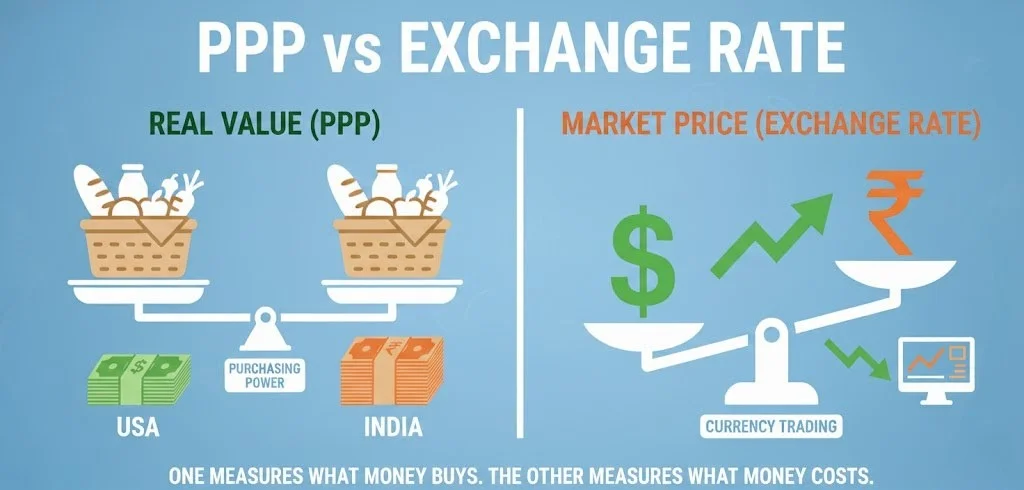
- Currency conversion and PPP are completely different. Exchange rates tell you how much rupees you get for your dollars. PPP tells you what those rupees can actually buy in India.
- India offers significantly higher purchasing power for the same salary number. Your money typically goes 4-5 times further in India compared to the USA, meaning lower costs for housing, food, and services.
- Remote work creates unique opportunities with PPP. If you earn a USA salary while living in India, your purchasing power increases dramatically, allowing for significant savings or enhanced lifestyle.
What is PPP and Why It Matters?
Purchasing Power Parity measures what your money can actually buy in different countries. It answers the real question: “How will my lifestyle change if I move from the USA to India, or vice versa?”
The PPP calculator compares prices of everyday goods and services. A basket of groceries that costs $100 in New York might cost only ₹1,500 (roughly $18) in Delhi. That difference matters far more than exchange rates when you’re planning your budget or evaluating a job offer.
Exchange rates fluctuate daily based on currency markets. Today, $1 equals approximately ₹90. But that rate doesn’t tell you that rent in Bangalore costs a fraction of what you’d pay in San Francisco, or that a restaurant meal in Mumbai costs less than a coffee in Manhattan.
When you’re comparing job offers or planning a relocation, PPP gives you the real numbers you need. It factors in actual costs you’ll face—housing, food, transportation, healthcare, entertainment, not just theoretical currency values.
How to Use the PPP Calculator India vs USA
The PPP calculator makes salary comparisons straightforward. You enter your salary in one country and see what you need in the other country to maintain the same purchasing power.
- Start by selecting your current country in the first dropdown. If you’re currently in the USA, select “United States.” Enter your annual salary in dollars, for example, $100,000.
- Next, select your target country in the second dropdown. Choose “India” for this comparison. The calculator instantly shows you the equivalent purchasing power in Indian rupees.
- The result tells you what salary you need in India to maintain your USA lifestyle. When you input $100,000 USD, the calculator shows ₹20,20,000 INR (₹20.2 lakhs). This means you need ₹20.2 lakhs in India to have the same purchasing power as $100,000 in the USA.
You can refer this step by step guide on how to use PPP Calculator.
Understanding this direction matters. The calculator doesn’t say “$100,000 USD equals ₹20.2 lakhs.” It says “to maintain the same purchasing power as $100,000 in the USA, you need ₹20.2 lakhs in India.”
Why PPP and Exchange Rates Give Different Numbers
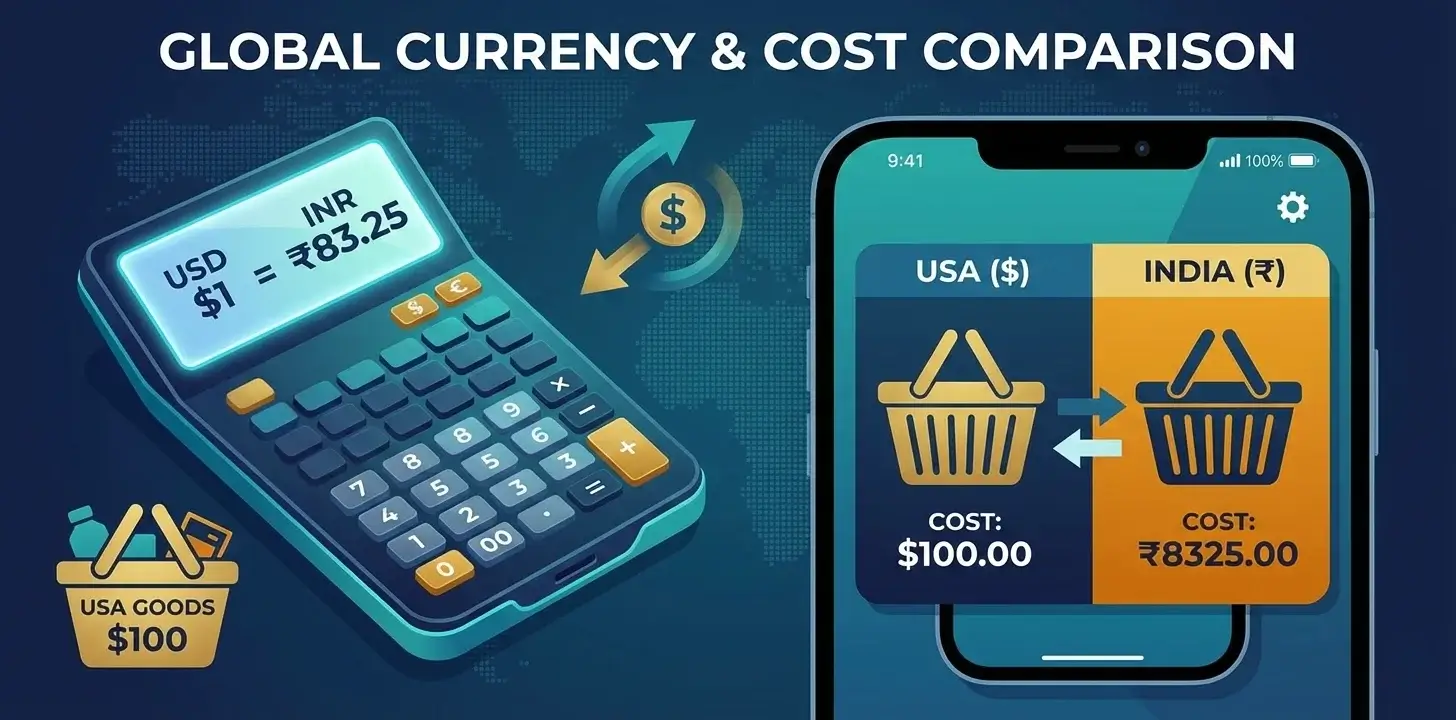
This confuses many people. Let’s clarify with a specific example.
Using the PPP calculator, $100,000 USD requires ₹20,20,000 INR in India for equivalent purchasing power. But if you convert $100,000 using exchange rates (at ₹90 per dollar), you get ₹90,00,000.
These numbers answer different questions. Exchange rate conversion answers: “How many rupees do I get for my dollars?” The answer is ₹90 lakhs.
PPP answers: “How many rupees do I need in India to buy what $100,000 buys in the USA?” The answer is ₹20.2 lakhs.
The gap exists because things cost less in India. A haircut costs $30-50 in the USA but ₹200-500 ($2.40-6) in India. A domestic flight costs $200-400 in the USA but ₹3,000-8,000 ($36-96) in India. Restaurant meals, groceries, rent—almost everything costs significantly less.
This is why earning USA salaries while living in India creates such strong purchasing power. You earn ₹90 lakhs (converted at exchange rates) but only need ₹20.2 lakhs for USA-equivalent lifestyle. The remaining ₹62.8 lakhs represents additional purchasing power that doesn’t exist in the USA.
Real Salary Examples: USA to India
Let’s examine specific salary scenarios to understand how purchasing power translates between countries.
Entry-Level Software Engineer
A junior software engineer in San Francisco earns $85,000 annually. Using the PPP calculator, this translates to needing ₹17,17,000 (₹17.2 lakhs) in India for equivalent purchasing power.
In reality, entry-level engineers in Bangalore or Hyderabad typically earn ₹6-10 lakhs. This means their nominal salary is lower, but their actual purchasing power exceeds what the USA salary provides. They can save more and maintain a comfortable lifestyle on what seems like a smaller number.
Mid-Career Professional
A mid-career marketing manager in Boston earning $100,000 needs ₹20,20,000 (₹20.2 lakhs) in India for the same purchasing power. Mid-level marketing professionals in Mumbai typically earn ₹15-25 lakhs, putting them in a similar purchasing power range.
However, the India-based professional likely pays less for housing as a percentage of income. A $100,000 earner in Boston spends 30-40% on housing. The ₹20 lakh earner in Mumbai spends 20-25%, leaving more for savings and other expenses.
Senior Tech Professional
A senior software engineer or tech lead in Seattle earning $150,000 would need ₹30,30,000 (₹30.3 lakhs) in India. Senior engineers in Indian tech hubs often earn ₹25-40 lakhs, placing them in comparable purchasing power territory.
Many senior professionals in India at this level enjoy higher relative purchasing power than their USA counterparts. They can afford domestic help, drivers, and premium housing that would be prohibitively expensive in the USA.
Remote Worker Scenario
Here’s where PPP creates interesting opportunities. If you earn a USA salary of $100,000 while living in India, you only need ₹20.2 lakhs for equivalent purchasing power. But you’re earning $100,000, which converts to approximately ₹83 lakhs at current exchange rates.
Your purchasing power increases by roughly 4x. You can save aggressively, invest substantially, or enjoy a significantly elevated lifestyle compared to local standards.
Cost Breakdown: USA vs India by Category
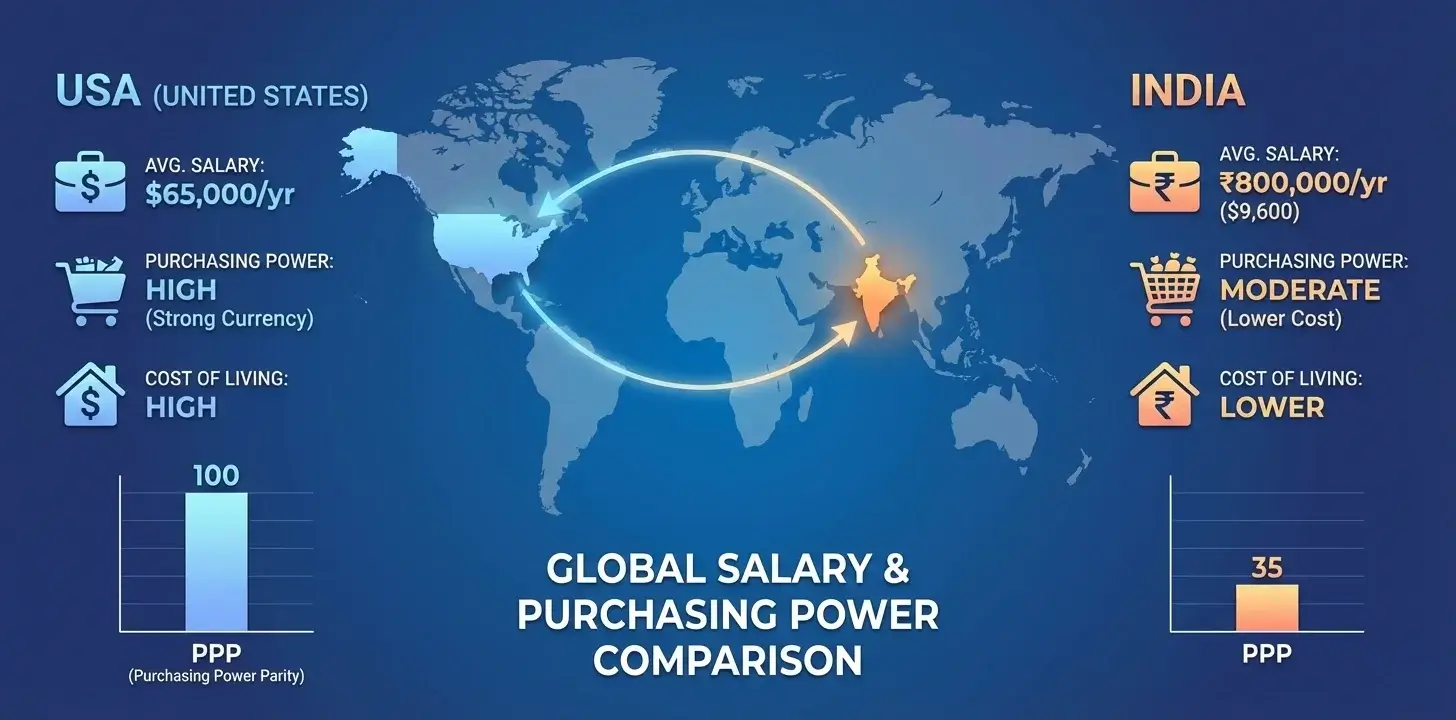
Understanding specific categories helps you plan budgets and evaluate offers more accurately as the cost of living difference between India and the USA is substantial. Most expenses in India cost 60-75% less than comparable items in the USA.
Housing Costs
USA major cities: $2,500-5,000 per month for a two-bedroom apartment in a good neighborhood. Indian major cities: ₹30,000-70,000 ($360-840) per month for comparable quality.
The percentage difference varies by city. San Francisco and New York show the biggest gaps. A $4,000 apartment in San Francisco has equivalent quality to a ₹50,000 ($600) apartment in Bangalore. That’s 85% cheaper in India.
Food and Groceries
Weekly grocery costs in the USA range from $150-250 for a family of four. In India, expect ₹4,000-8,000 ($48-96) for similar quality and quantity.
Restaurant meals show even bigger gaps. A meal for two at a mid-range restaurant costs $60-100 in USA cities. The same experience costs ₹1,200-2,500 ($14-30) in Indian cities.
Street food and local restaurants in India offer incredible value. A filling meal costs ₹100-300 ($1.20-3.60), making dining out affordable for daily life.
Transportation
Car ownership costs more in the USA overall. Purchase prices are similar, but insurance ($1,200-2,000 annually) and parking ($200-500 monthly in cities) add up. In India, car insurance costs ₹15,000-30,000 ($180-360) annually, and parking is often included with housing.
Public transportation in India is extensive and cheap. Delhi Metro monthly passes cost ₹800 ($10). Mumbai local trains cost even less. USA metro systems charge $100-150 monthly.
Ride-sharing in India costs a fraction of USA rates. A 10km ride costs ₹150-300 ($1.80-3.60) in India versus $20-30 in the USA.
Healthcare
This category shows complex differences. Quality private healthcare in India costs less in absolute terms. A doctor’s consultation costs ₹500-1,500 ($6-18) without insurance. USA consultations cost $150-300 even with insurance copays.
Hospital procedures show similar patterns. A standard surgery might cost ₹150,000-300,000 ($1,800-3,600) in India’s best private hospitals. The same procedure costs $15,000-30,000 in the USA even with insurance.
However, USA employers typically provide health insurance. In India, you might need to purchase private insurance separately, though premiums cost much less.
Education
International schools in India approach USA costs. Annual fees range from ₹5-20 lakhs ($6,000-24,000), similar to USA private schools. This is one category where costs converge.
Local private schools in India cost ₹50,000-200,000 ($600-2,400) annually, providing quality education at much lower cost than USA public schools require through higher taxes.
University education shows big differences. Indian engineering and medical schools charge ₹50,000-500,000 annually. USA equivalents cost $20,000-70,000.
Common Scenarios: Which Country Offers Better Value?
Different situations create different answers. Let’s examine specific scenarios.
Early Career Professional Building Savings
If you’re in your 20s or early 30s focused on aggressive saving, India offers better value when earning comparable purchasing power salaries. Your lower essential costs (housing, food, transportation) leave more for savings and investments.
A $80,000 salary in the USA provides reasonable living standards but limited savings in expensive cities. The PPP equivalent in India (₹16.2 lakhs) lets you save 40-50% of income while maintaining comfortable lifestyle.
Mid-Career Professional with Family
This depends heavily on your priorities. India offers better value for housing, domestic help, and daily living costs. The USA offers better public infrastructure, international travel access, and some consumer goods.
Families with children need to consider education costs carefully. International schools in India approach USA private school costs. However, high-quality local schools exist at much lower cost.
Healthcare quality at top Indian private hospitals matches USA standards at fraction of the cost. But USA employer health insurance often provides better coverage.
Remote Worker Earning USA Salary
This scenario heavily favors India. If you earn $100,000 remotely while living in India, you only need ₹20.2 lakhs for USA-equivalent lifestyle. Your actual salary converts to ₹83 lakhs, creating massive purchasing power surplus.
You can save 60-70% of income, invest aggressively, or enjoy premium lifestyle including domestic staff, premium housing, and frequent travel, all while building wealth faster than possible in the USA.
Retiree with Fixed Income
India offers excellent value for retirees with USA pensions or savings. A retirement income of $3,000 monthly ($36,000 annually) converts to ₹29.88 lakhs annually. You need only ₹7.3 lakhs for equivalent USA purchasing power.
This allows premium lifestyle including domestic help, nice housing, quality healthcare, and entertainment while your savings last much longer.
Tax Considerations Beyond PPP
PPP calculations don’t include taxes, which significantly impact take-home pay in both countries.
USA federal income tax on $100,000 ranges from 22-24% (depending on state and deductions). Add 5-10% for state and local taxes in most states. Your take-home is roughly $65,000-70,000.
India income tax on ₹20 lakhs is approximately 20-25% (depending on deductions). Your take-home is roughly ₹15-16 lakhs.
The USA often provides retirement benefits (401k matching), health insurance, and other benefits that increase total compensation. Indian companies increasingly offer similar benefits, but not as universally.
Calculating true compensation requires comparing total packages, not just base salary. Include health insurance value, retirement contributions, paid leave, and other benefits.
Using PPP for Salary Negotiations
The PPP calculator provides powerful negotiation data for remote work and international positions.
Negotiating Remote Work from India
If you’re moving from USA to India while keeping your USA employer, you can negotiate using PPP data. Show that you need only ₹20.2 lakhs for purchasing power equivalent to $100,000 in the USA.
Propose a salary adjustment that benefits both sides. Perhaps $70,000 instead of $100,000—still giving you excellent purchasing power in India (₹14.1 lakhs needed vs ₹58 lakhs received in conversion) while saving your employer 30% on compensation.
Present this professionally with data. Show the PPP calculations. Demonstrate that you maintain excellent quality of life while the company reduces costs.
Evaluating India to USA Job Offers
When you receive a USA job offer while working in India, run both calculations. First, determine what your current Indian salary buys in USA terms. A ₹25 lakh salary in India provides purchasing power equivalent to roughly $123,000 in the USA.
If your USA offer is $110,000, you’re actually taking a purchasing power cut despite higher nominal salary. Use this data to negotiate higher compensation or evaluate whether the move makes financial sense.
Setting Fair International Compensation
HR teams can use PPP to establish equitable global pay bands. If your USA engineers earn $120,000, your India engineers should earn ₹24.2 lakhs for equivalent purchasing power.
This approach maintains fairness while respecting local cost structures. It prevents situations where international employees feel underpaid despite competitive local salaries.
Beyond Salary: Quality of Life Factors
PPP calculations focus on purchasing power, but quality of life includes non-financial factors worth considering.
1. Infrastructure and Services
USA cities generally offer better public infrastructure—roads, public transportation, utilities, public services. Power outages are rare. Water quality is consistently high. Internet is reliable everywhere.
Indian cities are improving rapidly but still face infrastructure challenges. Power cuts occur in some areas. Water quality varies. Traffic congestion is severe in major cities.
However, India offers services the USA can’t match at any price. Domestic help (cooking, cleaning) costs ₹10,000-25,000 monthly, affordable for middle-class families. Drivers cost ₹15,000-25,000 monthly. These services dramatically improve quality of life but are unavailable or prohibitively expensive in the USA.
2. Healthcare Quality and Access
Top private hospitals in India (Apollo, Fortis, Max) provide excellent care at fraction of USA costs. Wait times are shorter. Care is personalized. But quality varies widely between facilities.
USA healthcare costs more but offers consistent quality standards. Insurance coverage, while expensive, provides security. Emergency services are reliable everywhere.
3. Work Culture and Lifestyle
USA work culture emphasizes work-life balance more than India, particularly in tech companies. Flexible schedules, remote work options, and generous leave policies are standard.
Indian work culture is evolving but often demands longer hours and weekend availability. However, the lower cost of living means single income can often support families comfortably, providing flexibility for one parent to focus on home or pursue other interests.
4. Climate and Environment
India’s climate varies by region. tropical in south, temperate in north, desert in west. Air quality in major cities remains a serious concern, particularly Delhi and Mumbai during certain seasons.
USA climate also varies widely by region. Air quality is generally better. But harsh winters in northern states and hurricane risks in coastal areas present challenges.
Common Mistakes When Using PPP Calculators
People frequently misinterpret PPP calculations. Avoid these errors.
1. Thinking PPP Equals Currency Conversion
The most common error is treating PPP output as currency conversion. When the calculator shows $100,000 USD needs ₹20.2 lakhs in India, people think “$100,000 equals ₹20.2 lakhs.”
That’s wrong. The calculator says “you need ₹20.2 lakhs in India to buy what $100,000 buys in the USA.” These are completely different statements.
If you convert $100,000 at exchange rates, you get ₹83 lakhs. If you need only ₹20.2 lakhs for equivalent purchasing power, your money goes 4x further in India.
2. Ignoring Lifestyle Differences
PPP assumes you maintain the same consumption patterns. But your lifestyle will change between countries.
In India, you might employ domestic help and a driver—costs that don’t exist in your USA budget. In the USA, you might spend more on consumer electronics and international travel, which cost less in the USA.
Use PPP as a starting point, then adjust for your actual planned lifestyle.
3. Forgetting Tax Differences
PPP calculations use gross salary. But you live on net salary after taxes.
Always calculate take-home pay in both countries. Tax rates, deductions, and benefits vary significantly. A seemingly equivalent PPP salary might leave you with very different disposable income.
4. Overlooking Non-Salary Compensation
Benefits matter enormously. USA employers typically provide health insurance, 401k matching, and stock options. Indian employers are improving but benefits packages vary widely.
Calculate total compensation value, not just base salary. Health insurance worth $15,000 annually significantly impacts your real income.
5. Treating All Indian Cities Equally
India shows huge variation between cities. Living costs in Mumbai and Bangalore exceed those in Pune or Hyderabad by 40-50%. Using national PPP averages might misrepresent your specific situation.
Similarly, USA costs vary enormously between San Francisco and Austin, or New York and Nashville. Research your specific cities for accurate planning.
Conclusion
Understanding purchasing power parity between India and the USA gives you the real numbers you need for smart financial decisions. The PPP calculator shows that $100,000 in the USA requires only ₹20.2 lakhs in India for equivalent purchasing power, revealing how much further money goes in India.
Use the PPP calculator before accepting international job offers, negotiating remote work compensation, or planning relocations. The difference between exchange rate conversion and purchasing power comparison can mean hundreds of thousands of rupees in actual spending power.
Remember that PPP provides the foundation, not the complete picture. Factor in taxes, benefits, lifestyle preferences, and quality of life elements beyond pure purchasing power. Your specific city, industry, and personal priorities all influence whether India or the USA offers better value for your situation.
Ready to compare your salary’s real value? Try the free PPP calculator now and see exactly what your money buys in India versus the USA.
PPP Calculator India vs USA – FAQ
Ans: Earning USA dollars while living in India provides maximum purchasing power since your income converts to ₹90 lakhs while you need only ₹20.2 lakhs for USA-equivalent lifestyle. However, earning in rupees while living in India provides stability without currency conversion risk.
Ans: PPP calculations using World Bank data provide reliable general guidance but don’t capture individual lifestyle differences. Actual costs vary significantly by city, lifestyle choices, and personal spending patterns. Use PPP as a starting point and adjust for your specific situation.
Ans: Moving to India offers significantly higher purchasing power for equivalent salaries, allowing aggressive savings or enhanced lifestyle. However, consider non-financial factors like infrastructure, healthcare access, work culture, climate, and proximity to family before deciding.
Ans: The Purchasing power parity calculator at pppcalculator.info uses official World Bank data to compare purchasing power between India, USA, and 180+ countries. It provides instant, accurate comparisons based on actual price level data rather than simple currency conversion.