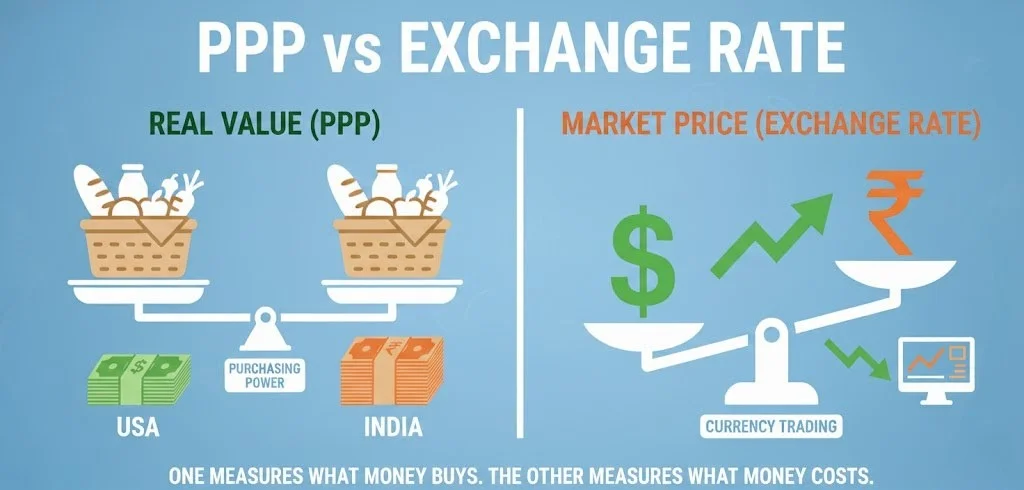
A software engineer in Bangalore earns ₹25 lakhs per year. Her colleague in Mumbai earns ₹32 lakhs for the same role. On paper, the Mumbai offer looks better. But after rent swallows 40% of his paycheck in a cramped Andheri flat, he watches her enjoy a spacious apartment in Koramangala with money left over for weekend getaways. The salary gap told one story. Purchasing power told another.
This is the gap that PPP calculators struggle with. When you use a PPP calculator to compare salaries between countries, you get one number for an entire nation. India gets a single PPP conversion factor of 20.20. That number applies equally to someone living in South Mumbai and someone in Jaipur, even though their daily costs differ dramatically.
If you have searched for a “PPP calculator by city” or “PPP calculator city wise,” you have already noticed the problem. So let us unpack why city-level PPP is so difficult, what alternatives actually work, and how to make smarter salary decisions when national PPP data is all you have.
Key Takeaways
- PPP data from the World Bank measures purchasing power at the national level only. It was never designed to capture price differences between cities within the same country.
- No reliable “city-wise PPP calculator” exists because the underlying methodology depends on nationwide price surveys across thousands of goods. Subnational PPP data remains experimental.
- Combining national PPP data with city-level cost of living indexes from platforms like Numbeo gives you a much more accurate picture than either tool alone.
- The PPP calculator works best for what it was built for: comparing purchasing power between two different countries using verified World Bank data.
Why PPP Data Only Works at the Country Level
The International Comparison Program, run by the World Bank, collects prices for roughly 3,000 goods and services across participating countries. These prices get averaged into a single conversion factor for each nation. India’s PPP factor of 20.20 means that, on average, what costs $1 in the United States costs about ₹20.20 in India when you account for local prices.
That phrase “on average” is doing enormous heavy lifting. India’s average includes street food vendors in Varanasi and Michelin-quality restaurants in Delhi. It blends rents in Bhopal with rents in South Mumbai. It smooths out the price of a haircut in Tier-3 cities with grooming salons in Gurugram.
The World Bank itself is clear about this limitation. Its official guidance on the ICP states that PPPs are pertinent to countries as a whole and cannot be used for comparisons between subnational regions. This is not a flaw in the data. It is a fundamental feature of how PPP is calculated.
Some countries have experimented with subnational PPP calculations. The U.S. Bureau of Economic Analysis publishes Regional Price Parities that measure price differences across states and metropolitan areas. But these are domestic tools, built with domestic CPI data. They are not compatible with the international PPP framework.
No country has a publicly available, verified system that lets you calculate PPP between, say, Bangalore and London at the city level.
The Real Price Gap Between Cities

To understand why a single national PPP number falls short, look at how much prices vary within countries.
Consider India. A one-bedroom apartment in Mumbai’s city center costs roughly ₹38,000 to ₹60,000 per month. In Bangalore, the same apartment runs ₹20,000 to ₹35,000. Move to Pune and you might pay ₹15,000 to ₹28,000. In Hyderabad, rents drop even further. Housing is typically the single largest driver of cost of living differences, and it varies by factors of two or three across Indian metros.
According to Numbeo’s comparison tool, you would need approximately ₹1,75,500 in Bangalore to match the lifestyle that ₹2,40,000 supports in Mumbai. That is a 27% difference in purchasing power between two cities in the same country, both using the same currency and the same national PPP factor.
The pattern repeats globally. In the United States, the Bureau of Economic Analysis found that California’s overall price level is about 12.6% above the national average, while Mississippi sits 12.7% below it.
The real value of $100 in San Francisco buys what roughly $83 buys nationally, while $100 in parts of rural Alabama stretches to about $119 worth of goods.
This means two people comparing salaries between the U.S. and India using PPP might get a perfectly accurate country-level result, but still make a poor decision if one lives in Manhattan and the other in Chennai.
What a PPP Calculator by City Would Need
Building a genuine PPP calculator for cities would require something the statistical world has not yet achieved at scale. Here is what it would take.
- First, you would need consistent price surveys across thousands of comparable goods in every city being compared. The current ICP surveys roughly 3,000 items per country, but collecting that data at the city level for hundreds of cities worldwide would be extraordinarily expensive.
- Second, you would need to define “baskets of goods” that reflect actual spending patterns in each city. People in Mumbai spend differently from people in Jaipur. Their housing choices, transportation habits, food preferences, and entertainment options differ. A single basket cannot capture all of this.
- Third, the data would need regular updates. The World Bank updates its PPP factors annually, but the underlying ICP benchmark surveys happen only every few years. City-level prices change even faster than national averages, driven by local real estate booms, infrastructure projects, and shifting job markets.
- The OECD acknowledged this challenge in a recent initiative. It found that most member countries lack dedicated subnational price indicators, and the absence of regional price data makes it difficult to get accurate information for comparing living conditions across regions.
Comparing Purchasing Power Between Cities
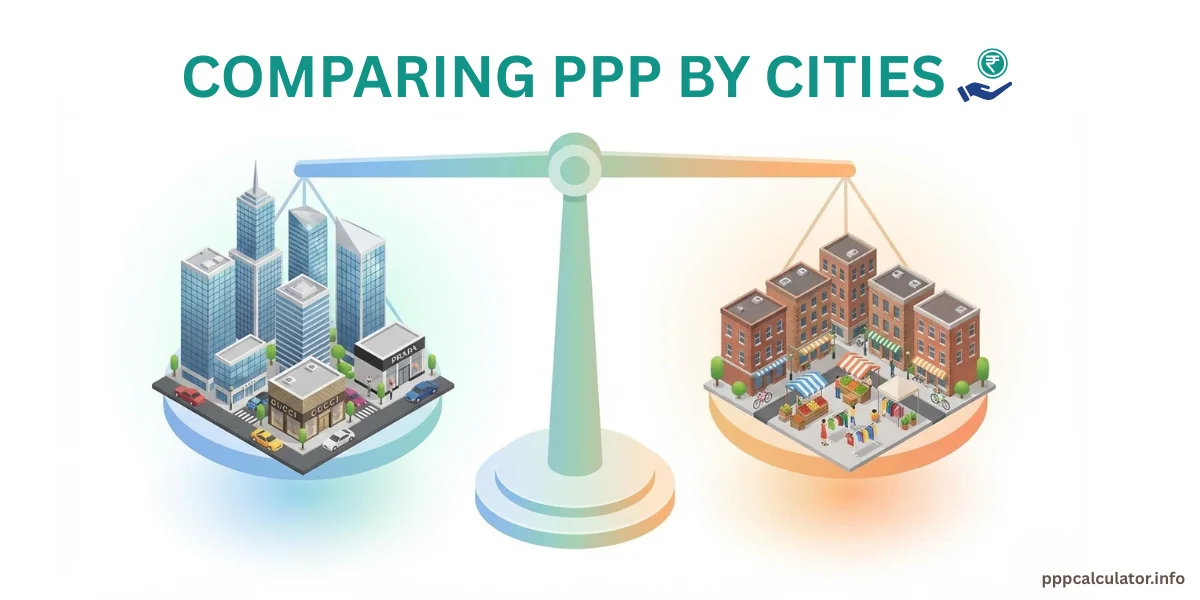
Since a true city-wise PPP calculator does not exist, here is a practical framework that combines the tools we do have.
For International City Comparisons (Different Countries)
When comparing cities in different countries, like London versus Bangalore or New York versus Delhi, use a two-step approach.
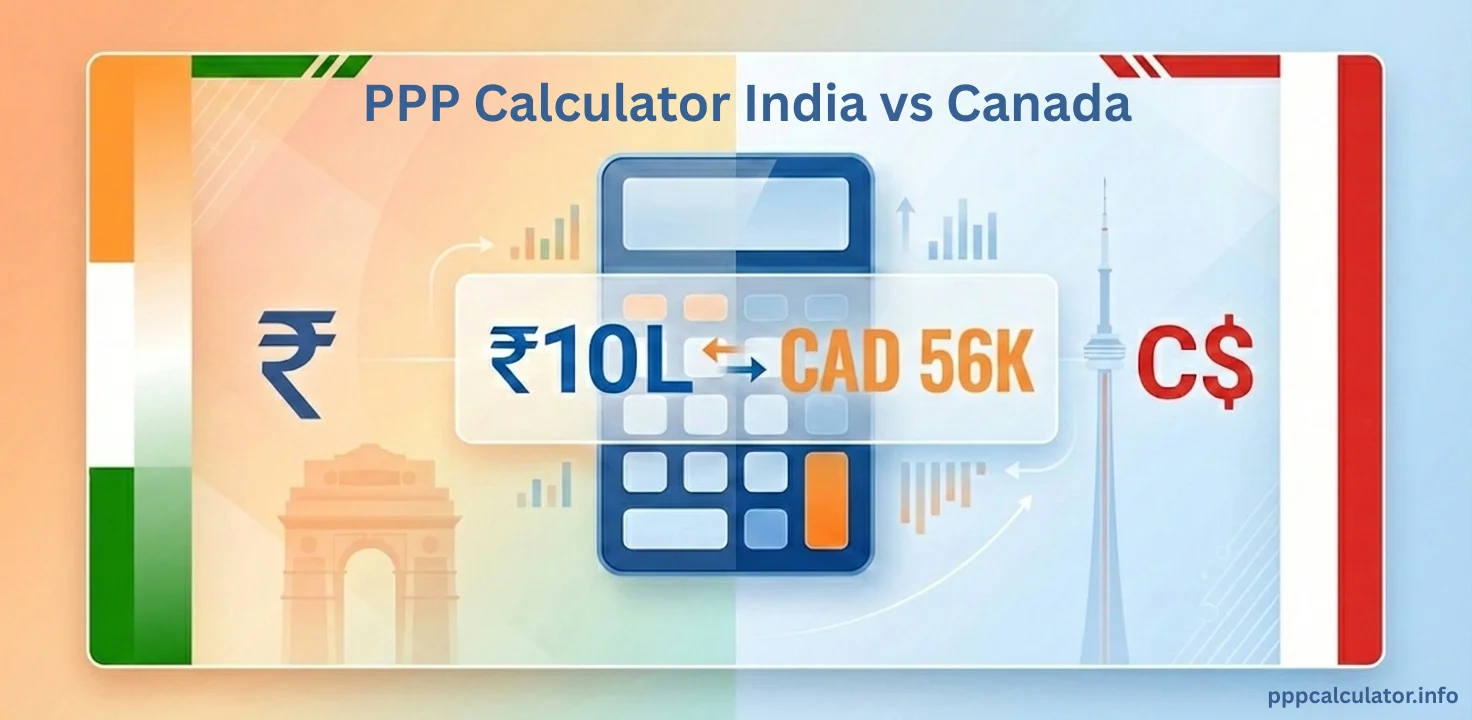
Start with the PPP calculator to understand the country-level purchasing power difference. For example, to match the purchasing power of $100,000 in the United States, you would need approximately ₹20.2 lakhs in India. This gives you the baseline.
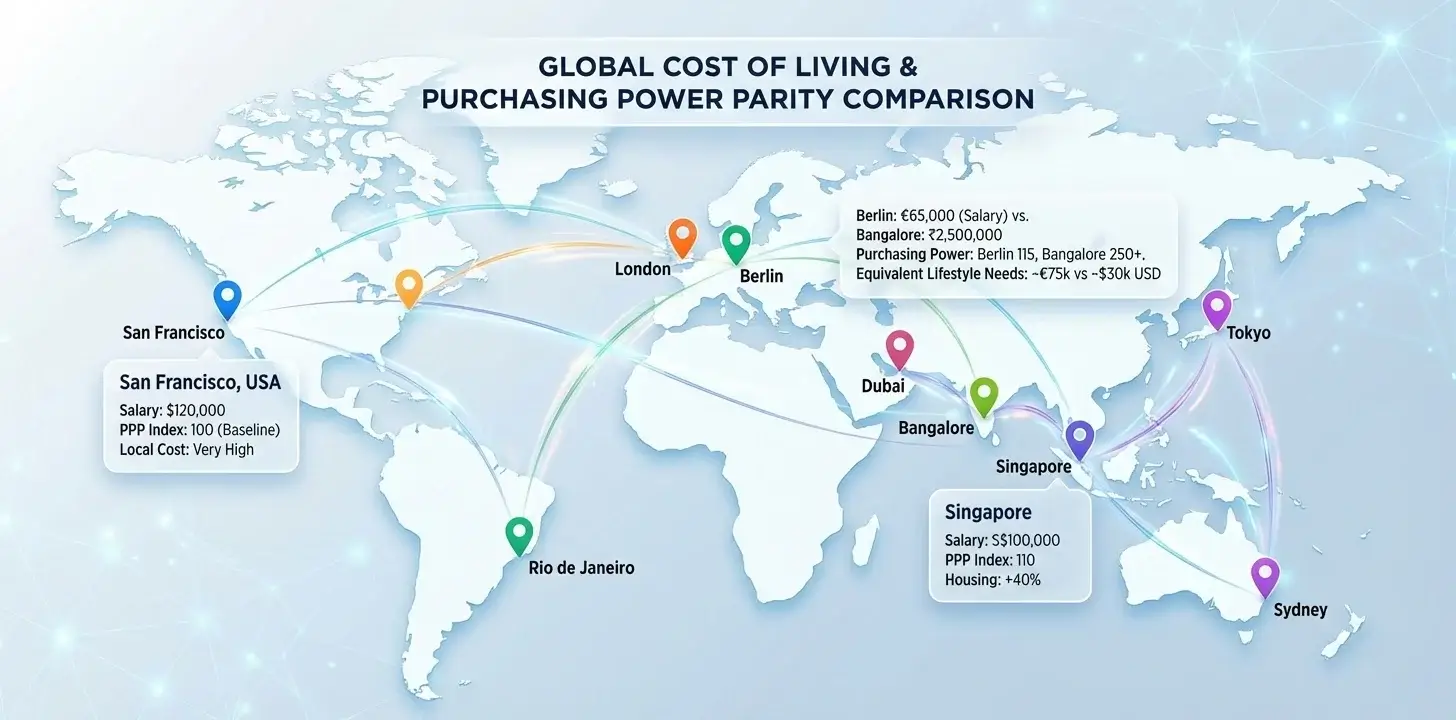
Then adjust for city-level cost of living within each country. If the person in the U.S. lives in San Francisco (roughly 15-20% above U.S. average) and the person in India lives in Hyderabad (roughly 15-20% below India’s metro average), the city-level adjustment might shift your PPP result by 30% or more.
Numbeo, Expatistan, and similar platforms let you compare specific cities directly. While their methodology differs from PPP, and their crowdsourced data has limitations, they capture the city-level variation that national PPP data cannot.
For Domestic City Comparisons (Same Country)
When comparing cities within the same country, such as Mumbai versus Bangalore or New York versus Austin, PPP is the wrong tool entirely. Both cities use the same currency. The PPP conversion factor would be 1:1 because you are not crossing any currency boundary.
For these comparisons, use dedicated cost of living calculators. Numbeo lets you enter a salary in one city and see the equivalent amount needed in another. The U.S. Bureau of Economic Analysis publishes Regional Price Parities for American metros. Bankrate and Salary.com offer similar domestic comparison tools.
These tools directly answer the question that brings many people to search for “PPP calculator India cities” or “PPP calculator state wise.” If you are weighing a job offer in Bangalore against one in Pune, you do not need purchasing power parity. You need a cost of living comparison.
For Salary Negotiations Across Borders
If you are negotiating a remote work salary or evaluating an international job offer, use the international salary comparison approach. Start with country-level PPP from our homepage calculator, then layer on city-specific adjustments.
For example, say a company offers you ₹30 lakhs to work from Bangalore for a U.S.-based team. The PPP calculator shows that ₹20.2 lakhs in India has the purchasing power of $100,000 in the U.S. That puts your ₹30 lakhs at roughly $148,500 in U.S. purchasing power terms.
But the team you are joining is based in San Francisco, where costs are well above the U.S. national average. And you are in Bangalore, which sits below India’s most expensive city (Mumbai).
Factoring in these city-level realities, your ₹30 lakhs might actually deliver a lifestyle closer to what someone earning $160,000-$170,000 experiences in San Francisco.
This layered approach is not perfect, but it is far more accurate than using national PPP alone or abandoning PPP entirely.
Why Numbeo and PPP Are Not the Same Thing
If you have searched for “PPP calculator by city,” you have likely encountered Numbeo’s cost of living comparison tool. It is worth understanding how Numbeo and PPP differ, because confusing them leads to mistakes.
- PPP conversion factors come from the World Bank’s International Comparison Program. Trained statistical agencies in each country collect prices using standardized methods. The data covers roughly 3,000 goods and services. It is designed for macro-level economic comparisons, like adjusting GDP figures across nations.
- Numbeo relies on crowdsourced data from users around the world. Anyone can submit prices, and while the platform uses spam filters and validation algorithms, the data is not peer-reviewed or officially verified. Its strength is coverage. Numbeo has price data for over 12,000 cities worldwide, far more granular than anything the World Bank offers.
- Neither tool is “better” in absolute terms. PPP is more rigorous but only works at the country level. Numbeo is more granular but less standardized. For the most informed decision, use both. PPP gives you the trusted baseline for cross-country comparisons. Numbeo helps you adjust for the specific cities involved.
The cost of living calculator post on our site explores these tool differences in greater depth if you want a more detailed comparison of PPP, Numbeo, and other approaches.
Scenarios Where City-Level Data Matters
The Remote Worker Choosing a Base
Imagine a developer earning $80,000 from a U.S. company. She is considering Lisbon, Bangalore, or Mexico City as her home base. PPP tells her that the country-level purchasing power of $80,000 is very different in Portugal, India, and Mexico. But within each country, her actual lifestyle depends heavily on which city she picks.
In India alone, choosing Bangalore versus Mumbai versus Jaipur changes her effective spending power by 20-35%. The country-level PPP comparison gets her in the right ballpark. City-level cost of living data gets her to the right answer.
Our remote worker salary adjustment guide covers more frameworks for making this kind of decision.
The Expat Evaluating Two Offers
A finance professional gets offers from Deutsche Bank in Frankfurt and HSBC in Mumbai. The PPP calculator shows that Germany’s conversion factor of 0.728 versus India’s 20.20 creates a significant purchasing power difference at the country level.
But Frankfurt is one of Germany’s most expensive cities. Mumbai is India’s most expensive city. Both sit well above their national averages. The city-level premium in each case narrows the gap that PPP suggests. Without accounting for this, the candidate might overestimate the purchasing power advantage of one offer over the other.
The HR Team Setting Location-Based Pay
Companies with distributed teams increasingly use geographic salary bands. Some apply PPP-based adjustments to set pay in different countries. But smart compensation teams go a step further. They apply city-tier adjustments within each country.
A company might pay the full U.S. market rate for someone in San Francisco, 90% for someone in Austin, and 80% for someone in a small town. On the India side, they might set a Bangalore rate, then adjust down 10-15% for Hyderabad and 20-25% for smaller cities. This layered approach mirrors the two-step framework described above.
Limitations to Keep in Mind
Even the best combination of PPP and cost of living tools has blind spots that matter.
- Lifestyle differences are hard to quantify. The “basket of goods” in PPP data assumes an average consumption pattern. If you spend heavily on international travel, imported electronics, or luxury goods, PPP overstates your purchasing power in lower-cost countries because those items are priced at global market rates, not local rates.
- Quality differences hide behind identical category names. “Healthcare” in Mumbai and “healthcare” in London represent very different experiences. “Public transportation” in Delhi and “public transportation” in Tokyo are hardly comparable. PPP and cost of living indexes treat these as equivalent spending categories, but you may value the quality gap enough to pay more for it.
- Tax structures change the math dramatically. India’s income tax rates, Germany’s social security contributions, and Dubai’s zero income tax all affect your take-home pay in ways that neither PPP nor cost of living tools capture.
Understanding what PPP actually measures, as explained in our guide on what is purchasing power parity, helps you interpret the numbers with the right level of confidence.
Making the Best Decision With the Data You Have
The search for a PPP calculator by city reveals a genuine gap in the available economic data. National PPP is a powerful tool for comparing purchasing power across borders. But it was built for economists comparing nations, not individuals comparing neighborhoods.
Until statistical agencies solve the subnational PPP puzzle, the smartest approach combines the tools we already have. Start with the PPP calculator on our homepage for your cross-country baseline. Then refine with city-level cost of living data. And always account for the personal factors, like taxes, lifestyle preferences, and career trajectory, that no calculator can measure for you.
The number on your offer letter is just the beginning. What that number buys in the city where you actually live is what matters.
PPP Calculator by City – FAQ
Ans: No. PPP measures purchasing power differences between countries, not cities within the same country. Since Mumbai and Bangalore both use the Indian Rupee, the PPP factor is identical. For within-India comparisons, use a cost of living comparison tool like Numbeo, which shows that Bangalore is roughly 25-30% cheaper than Mumbai for an equivalent lifestyle.
Ans: The International Comparison Program collects prices at the national level, averaging data from various cities and regions. Building reliable city-level PPP would require consistent price surveys across thousands of goods in every city, which is extremely resource-intensive. The World Bank has acknowledged the growing demand for subnational PPP, but no standardized city-level dataset exists yet.
Ans: Numbeo provides useful directional data, but it relies on crowdsourced submissions rather than systematic price surveys. Its accuracy improves for well-covered cities like London and New York, where thousands of users contribute data. For smaller cities, the sample sizes shrink and results become less reliable. Treat Numbeo as a helpful estimate rather than a precise measurement.
Ans: Use a two-step approach. First, run the comparison through a PPP calculator using World Bank data to establish the country-level baseline. Then adjust for city-specific cost of living using Numbeo or similar tools. This layered method accounts for both the international purchasing power gap and the local price variation that national PPP data cannot capture.
Ans: No. The World Bank assigns one PPP conversion factor per country. India’s factor of 20.20 applies nationwide. However, cost of living varies significantly across Indian states and cities. For state-wise or city-wise comparisons within India, use domestic cost of living tools rather than PPP.

Jitender is the founder and lead developer of PPPCalculator.info, with a background in software development and international economics. He created this free tool to bridge the gap between currency conversion and real purchasing power, helping professionals across 50+ countries make informed salary decisions. He regularly translates complex World Bank and OECD data into practical guides for remote workers and expats.