Quick Reference: What Canadian Salary Matches Your Indian Salary?
| Indian Annual Salary | Equivalent Canadian Salary Needed |
|---|---|
| ₹8,00,000 (₹8 lakhs) | CAD 45,100 |
| ₹12,00,000 (₹12 lakhs) | CAD 67,600 |
| ₹20,00,000 (₹20 lakhs) | CAD 1,12,700 |
| ₹30,00,000 (₹30 lakhs) | CAD 1,69,000 |
Calculated using World Bank PPP conversion factors. India: 20.202558 | Canada: 1.137311.
Here is a number that changes how you see a Canadian job offer: CAD 1,12,600.
That is what you need to earn in Canada to have the same purchasing power as ₹20 lakhs in India. Not ₹20 lakhs converted at today’s exchange rate, which would give you something like CAD 2,35,000. Just CAD 1,12,600. Because Canada is expensive, but not that expensive.
The gap between what exchange rates say and what PPP says is where most people go wrong when they evaluate a move to Canada. They look at the exchange rate, see that CAD 1 is worth about ₹60 to ₹65, and feel like any Canadian salary sounds enormous. Then they land in Toronto or Vancouver, start paying rent, and realize that CAD 2,200 a month for a one-bedroom apartment is gone before they’ve bought a single grocery.
India vs Canada PPP guide explains exactly what that means for your situation and what salary you actually need to come out ahead.
Key Takeaways
- The PPP calculator shows purchasing power equivalence, not currency conversion. CAD 1,12,600 in Canada has the same purchasing power as ₹20 lakhs in India.
- Canada’s housing costs are the single biggest gap between the two countries. Rent can absorb 35 to 50 percent of take-home pay in Toronto and Vancouver.
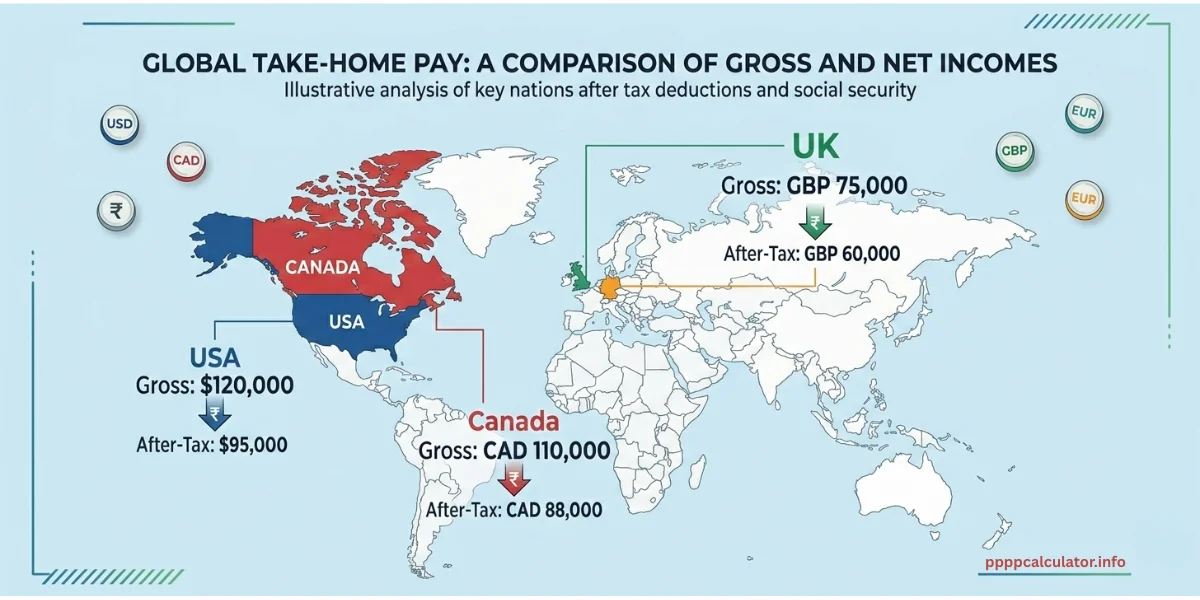
- Your gross Canadian salary and your real take-home are quite different. Federal and provincial taxes, Canada Pension Plan contributions, and Employment Insurance premiums together reduce a CAD 1,00,000 salary by roughly 28 to 33 percent depending on which province you live in.
- PPP uses national averages. The actual purchasing power difference between your Indian city and your Canadian city matters just as much as the national comparison.
What PPP Calculator Is Showing You?
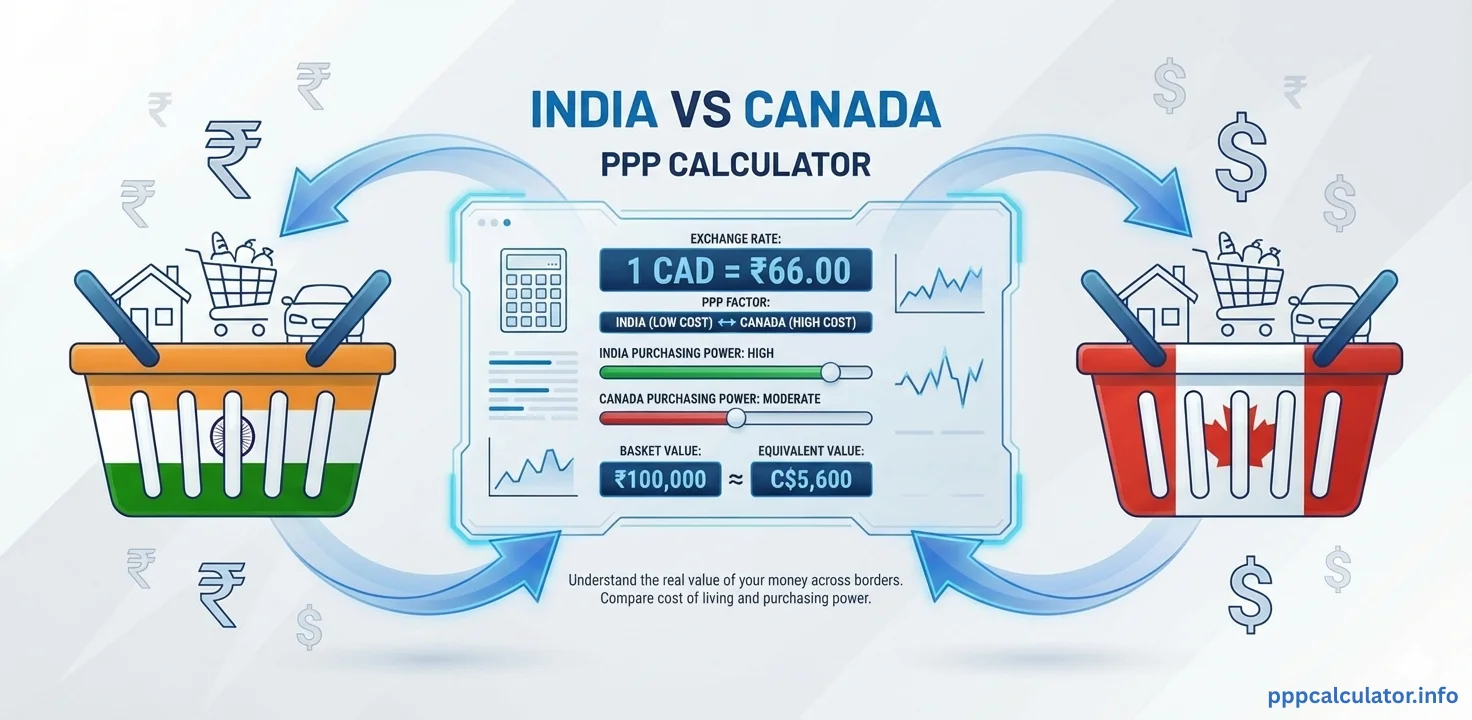
The PPP comparison uses World Bank data to compare the cost of an identical basket of goods and services across countries. That basket includes food, housing, clothing, healthcare, education, transportation, and other everyday expenses.
The calculation works like this: India’s PPP conversion factor is 20.20, meaning one international dollar buys goods worth ₹20.20 in India. Canada’s factor is 1.14, meaning one international dollar buys goods worth CAD 1.14 in Canada. The ratio between those two numbers tells you how much more expensive Canada is in real terms.
To understand why this is different from an exchange rate, think of it this way. An exchange rate tells you how much a Canadian dollar is worth in rupees on currency markets today. PPP tells you what a Canadian dollar can actually buy compared to what a rupee can buy. Those are two very different questions.
A software developer in Pune earning ₹20 lakhs can afford a comfortable two-bedroom apartment, a car, restaurant meals several times a week, and meaningful savings. To afford those same things in Mississauga, they need about CAD 1,12,600. That is the PPP number. It has nothing to do with converting ₹20 lakhs at current exchange rates.
If you want to understand more about how this calculation works under the hood, the PPP formula guide explains the methodology in detail.
Real Salary Comparisons India to Canada
Let’s look at verified examples across different salary levels to understand purchasing power differences:
Early in your career: ₹8 lakhs in India vs Canada
If you are earning ₹8,00,000 in India, you need CAD 45,000 in Canada to maintain the same purchasing power.
This is worth pausing on. The average entry-level salary for an Indian immigrant in Canada in their first year is often in the CAD 45,000 to CAD 60,000 range, depending on the field and the city. That means the purchasing power equivalence is often roughly met at entry level. You are not gaining and you are not losing, in terms of what your money can buy day to day.
What actually changes is the floor. In Canada, minimum wage, healthcare access, and employment protections mean your downside risk is lower. But the savings potential in your first couple of years is often much thinner than people expect.
Mid-career: ₹20 lakhs in India vs Canada
If you earn ₹20,00,000 in India, you need CAD 1,12,600 in Canada to maintain equivalent purchasing power.
At this level, the comparison gets more nuanced. A mid-career professional in India earning ₹20 lakhs likely has some combination of help at home, a car, housing that is owned or at low rent relative to income, and access to affordable services. In Canada, CAD 1,12,600 gross in Toronto looks like roughly CAD 77,000 to CAD 80,000 after federal and Ontario taxes, CPP contributions, and EI premiums.
That take-home has to cover rent, which in Toronto averages CAD 2,200 to CAD 2,800 for a one-bedroom, plus a car, plus groceries, plus the services you used to afford cheaply in India that are now priced at Canadian labour rates.
The PPP number says equivalence. Your lived experience at this level often feels tighter than it did in India.
Senior professional: ₹30 lakhs in India vs Canada
If you earn ₹30,00,000 in India, you need CAD 1,68,900 in Canada to maintain equivalent purchasing power.
At this level, the Canada calculation starts to improve. Senior professional salaries in tech, healthcare, and finance in Canada regularly clear CAD 1,50,000 to CAD 2,00,000. If you land a role at or above the PPP equivalent, the combination of stable currency, clear retirement contributions, and public healthcare starts working in your favour.
Savings in Canada at this salary level are real. The CPP contributions that feel like a deduction now come back to you in retirement. Healthcare costs that you might be paying out of pocket in India, especially as parents age, are not your concern in Canada.
What the PPP Number Does Not Account For
The calculator gives you a clean national comparison. Real life adds several factors on top of that.
The province matters as much as the country
Canada’s provinces set their own income tax rates, and the difference is substantial. Alberta charges no provincial income tax. Ontario charges 9.15 to 13.16 percent on top of federal rates. On a CAD 1,00,000 salary, that provincial difference alone is roughly CAD 6,000 to CAD 8,000 per year in take-home pay.
For someone weighing Toronto against Calgary, the same job offer produces meaningfully different actual income. Calgary also has lower average housing costs than Toronto, which compounds the advantage. The PPP calculator cannot capture this because it works at the country level.
The hidden cost of losing household help
This one barely gets mentioned in salary comparison guides, and it matters enormously for Indian professionals. In India, having household help, a cook, or a driver is normal at mid-career income levels. That access disappears in Canada. The labour that was affordable at ₹20 lakhs in India is priced out of reach in Canada unless you are earning well above the PPP equivalent.
If you currently have help at home, factor in how that changes your time budget, your childcare costs, and your day-to-day quality of life. It does not show up in the purchasing power number but it is very real.
Remittances change the math
Many Indian professionals in Canada send money home regularly. At current exchange rates, CAD 1 converts to roughly ₹60 to ₹65. If you are sending CAD 2,000 a month home, that is ₹1.2 to ₹1.3 lakhs per month, which is genuinely substantial relative to Indian expenses. The exchange rate advantage on remittances is not captured in PPP, which is a purchasing power measure, not a currency transfer measure.
For a dual-income family where one earner stays in India, a Canadian salary can fund a very comfortable life on both ends. This is a dynamic that makes the Canada move financially Understanding what drives these PPP differences helps you evaluate job offers more accurately.
Canada to India: If You Are Already in Canada
If you are earning in Canada and thinking about returning to India, or if you are evaluating an Indian offer, the calculation runs the other direction.
To have the same purchasing power as CAD 80,000 in Canada, you would need approximately ₹14.21 lakhs in India. To match CAD 1,00,000 in Canada, you would need approximately ₹17.75 lakhs in India.
These numbers often surprise people. CAD 80,000 sounds like a lot, but in purchasing power terms, it corresponds to a solidly mid-level Indian salary. If you have been in Canada for several years and your Indian opportunities have kept pace with salary growth there, a return can look financially neutral or better, especially if you are moving back to a lower-cost city.
The Province Question: Where in Canada Are You Going?
The PPP comparison for Canada is national, but Canada is not uniform. Toronto and Vancouver have some of the highest housing costs of any English-speaking city in the world. Calgary and Edmonton are significantly cheaper. Halifax and Winnipeg cheaper still.
A CAD 90,000 salary in Halifax gives you a genuinely comfortable life. The same salary in Vancouver requires careful budgeting and will likely mean a long commute from a more affordable suburb. The PPP-equivalent salary for your Indian income is a starting floor, not a target. In expensive cities, you want to be earning noticeably above it.
For anyone comparing multiple destinations, the PPP comparisons hub covers how other corridors compare.
Using PPP Calculator for a Salary Negotiation
If you have a Canadian job offer in hand, here is how to use the PPP number as a negotiation anchor.
Start with the PPP equivalent of your current Indian salary. That is your baseline, the number at which you are financially neutral in purchasing power terms. Then add a premium for the actual higher cost of housing in your target city, the loss of tax efficiency in high-provincial-tax provinces, and the transition costs of the first six to twelve months where you will be setting up a new life.
A reasonable negotiation position for someone earning ₹20 lakhs in India, moving to Toronto in a mid-career role, might look like: PPP equivalent of CAD 1,12,600, plus a Toronto housing premium of perhaps CAD 15,000 to CAD 20,000, putting the realistic target somewhere around CAD 1,25,000 to CAD 1,30,000 for equivalent financial stability.
That is a very different number from either the raw PPP figure or what someone might naively estimate from exchange rates.
The Salary Comparison by Country Context
Canada sits in an interesting position when you look at salary comparisons across countries. It is more expensive than the UK in purchasing power terms for an Indian immigrant, but offers clearer immigration pathways. It is less expensive than the US but has more accessible permanent residency.
The PPP math is roughly comparable to Australia, but Canada’s immigration intake from India has historically been larger, which means the established community infrastructure is more developed.
Where Canada stands apart financially is the combination of universal healthcare, CPP, and the absence of the employer-driven visa anxiety that comes with US work authorization. Those are hard to price but they are real parts of the compensation picture.
Conclusion
The PPP calculator gives you the most honest starting point for comparing an Indian and Canadian salary. It cuts through the exchange rate noise and tells you what your money can actually buy.
What it gives you is a baseline. CAD 1,12,600 matches ₹20 lakhs in purchasing power. Below that, you are taking a real terms pay cut. Above it, you are gaining purchasing power in Canada.
What it does not give you is the full picture. Province, city, your family’s living situation, the value of Canadian healthcare and immigration permanence, the cost of losing household help, and the exchange rate benefit on remittances all shape whether the move makes financial sense for your specific situation.
Use the PPP salary calculator to establish your baseline number, then layer in the Canada-specific factors to build the real comparison.
PPP Calculator India vs Canada – FAQs
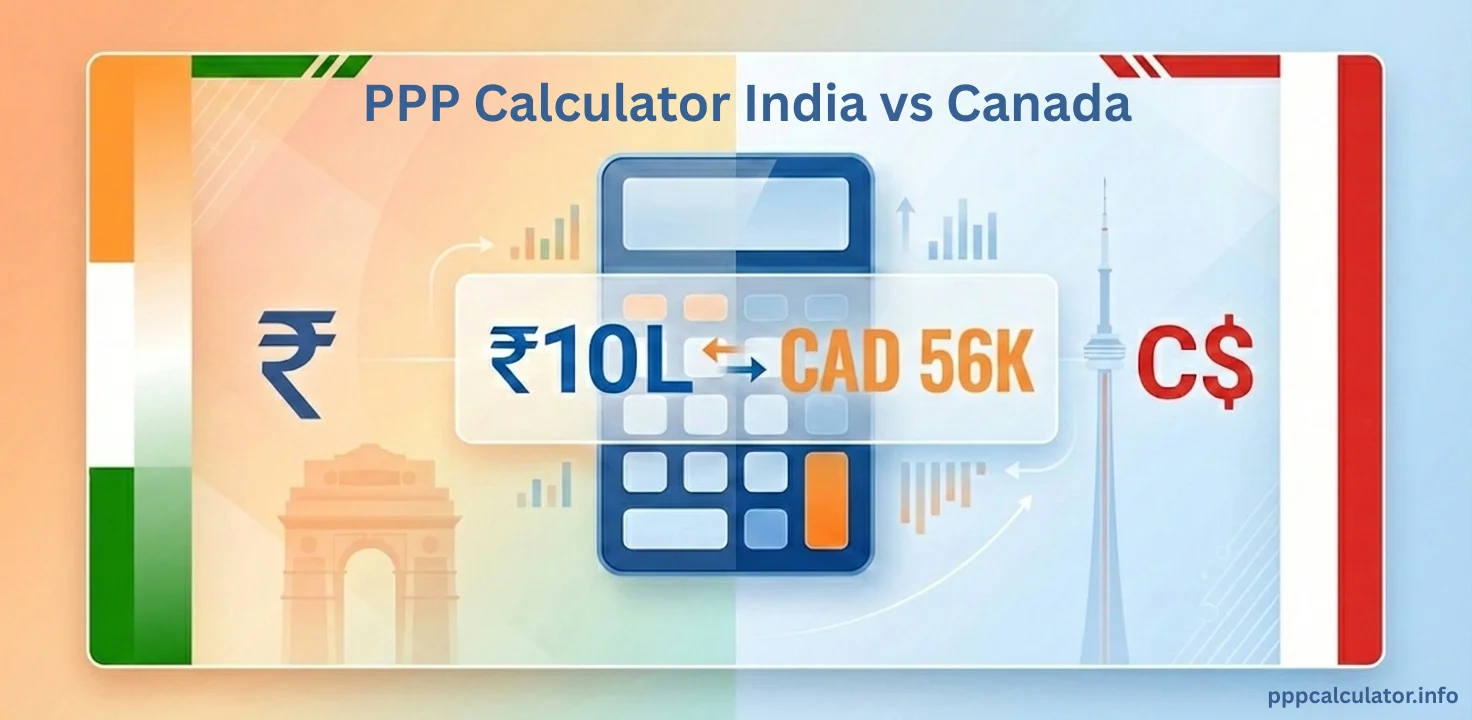
To maintain the same purchasing power as ₹10,00,000 in India, you would need approximately CAD 56,300 in Canada. This varies based on specific cities and personal spending patterns.
CAD 70,000 is approximately equivalent to ₹12 lakhs in India in terms of purchasing power. It’s considered a decent middle-class salary in smaller Canadian cities, but may be tight in expensive cities like Toronto or Vancouver.
To match ₹20 lakh Indian salary’s purchasing power, you need approximately CAD 1,12,700 in Canada. However, this varies significantly by city and lifestyle choices.
No, PPP calculators show gross salary equivalents based on purchasing power. You must separately calculate after-tax income in both countries for accurate comparison.
The PPP calculator uses national-level data, so it gives the same result regardless of province. In practice, province matters significantly.

Jitender is the founder and lead developer of PPPCalculator.info. He created this free tool to bridge the gap between currency conversion and real purchasing power, helping professionals across 50+ countries make informed salary decisions. He regularly translates complex World Bank and OECD data into practical guides for remote workers and expats.