
Pay Parity vs Purchasing Power Parity is an interesting battle, HR teams running global compensation reviews routinely mix up two concepts that sound related but answer completely different questions.
Pay parity asks – are we paying people fairly relative to each other? whereas Purchasing power parity asks – does a salary in one country actually buy the same life as a salary in another? Confusing them produces compensation structures that look equitable on paper but leave employees in some countries significantly better or worse off than intended.
What Pay Parity Means in Compensation
Pay parity is an internal equity standard. It means that employees doing comparable work receive comparable pay, regardless of gender, race, ethnicity, or other protected characteristics.
A company with genuine pay parity for its software engineers in Berlin pays those engineers based on role, seniority, and performance, not on who they are. The comparison is always people-to-people within the same context.
Pay parity audits typically involve comparing salary distributions across demographic groups, looking for unexplained gaps.
The EU Pay Transparency Directive required member states to implement disclosure laws by 2026. For companies with European operations, pay parity audits have moved from best practice to compliance requirement.
In the US, more than 25% of workers were already covered by pay transparency laws as of 2025, with several more state-level laws taking effect that year.
Pay parity is entirely a fairness and compliance discipline. It doesn’t ask whether a Berlin salary covers rent in Berlin. It asks whether Ana and Michael, both senior engineers in Berlin with equivalent experience, are earning the same amount.
What Purchasing Power Parity Measures
Purchasing power parity is a geographic comparison, not a demographic one.
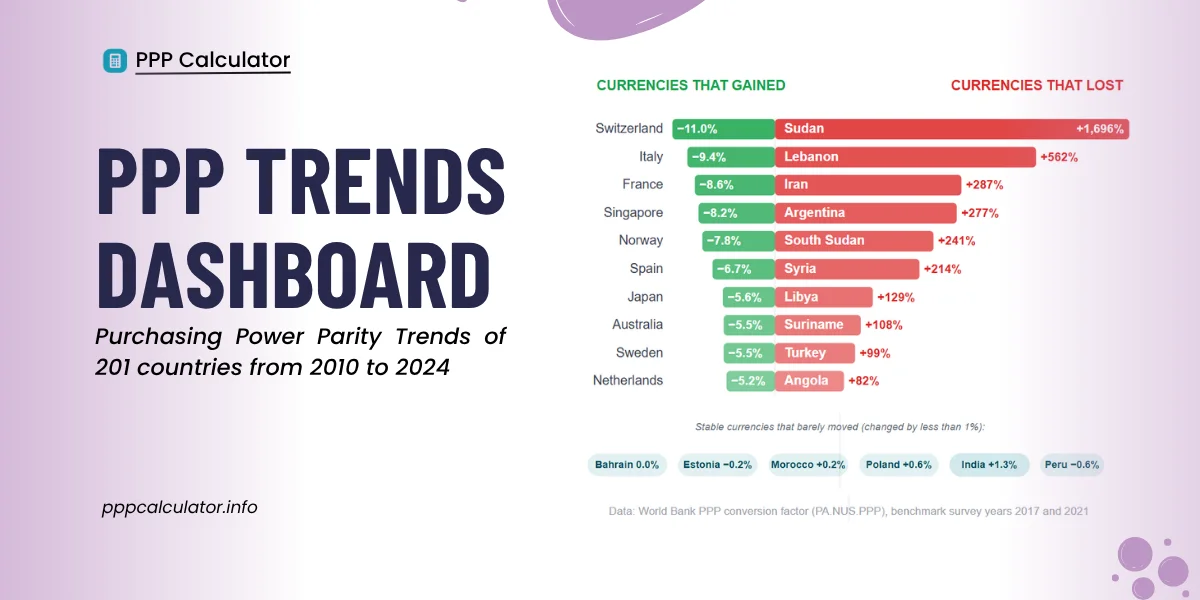
It measures what a salary actually buys in a given country by comparing the cost of the same goods and services across economies. The World Bank publishes PPP conversion factors annually, derived from roughly 3,000 goods and services measured across 196 countries.
These figures are the standard used by the IMF, World Bank economists, and compensation benchmarking teams at multinational companies.
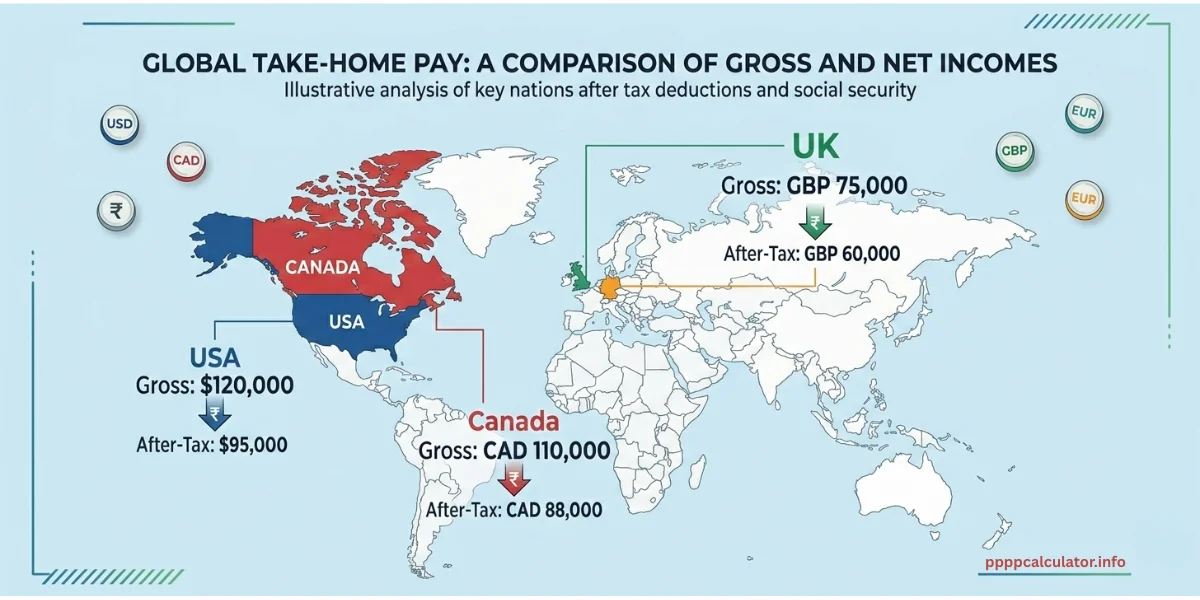
The difference between pay parity and PPP becomes obvious with a real example: A software company decides to pay every engineer on its global team $120,000 to achieve “pay parity.” The US engineer, the UK engineer, and the engineer in Bangalore all receive the same number.
Here’s what those salaries actually deliver in purchasing power for same lifestyle, using World Bank 2024 data, updated in 2026:
| Location | Salary Paid | PPP-Equivalent Needed |
|---|---|---|
| USA | $120,000 | $120,000 (baseline) |
| UK | $120,000 | £79,698 |
| Germany | $120,000 | €84,103 |
| Spain | $120,000 | €67,453 |
| India | $120,000 | ₹24.5 lakhs |
The US engineer and the UK engineer are being paid identical nominal amounts. But the UK engineer, converting at market rates and living in London, has significantly more purchasing power than their US counterpart.
The engineer in Bangalore, earning $120,000 in USD, has purchasing power equivalent to roughly ₹1.2 crore in India, several times what any comparable local role would pay.
Equal pay in nominal terms does not mean equal living standards across borders.
Why HR Teams Mix Up These Two Concepts

The confusion is understandable. Both concepts involve comparing salaries, both are frameworks for ensuring fairness, and both carry the word “parity” in popular usage. But the error usually starts with a well-intentioned simplification: “We pay everyone the same, so we’re treating everyone fairly.”
That logic works inside a single country, where cost of living is relatively consistent across employees in similar roles. It breaks down the moment you’re setting salaries across countries with structurally different costs.
Paying a Barcelona-based designer the same dollar amount as a San Francisco-based designer isn’t equal treatment. It’s overpayment in lifestyle terms on one side, and a potential retention problem on the other.
Discussion threads on international HR forums frequently surface this tension, particularly at companies expanding into Eastern Europe or Southeast Asia. Teams set “global pay parity” policies and then find themselves pricing out local talent who prefer locally-benchmarked packages.
Or the opposite: colleagues in lower-cost cities realize their USD salaries make them significantly wealthier in local terms than peers in New York or London, and the internal resentment runs the other way.
The Difference Between Pay Parity and PPP in Practice
The practical difference comes down to what question you’re trying to answer.
Pay parity answers: Is someone being underpaid because of who they are?
PPP answers: Does this salary provide the same standard of living in this country as a comparable salary does elsewhere?
A well-designed global compensation framework uses both. Pay parity analysis ensures there are no demographic gaps within any given location. PPP analysis informs the initial salary bands for each location.
The goal is for a role at a given seniority level to deliver roughly equivalent lifestyle outcomes, whether the employee is based in Warsaw, Nairobi, or Toronto.
Many international compensation teams use a tiered approach: country clusters grouped by cost level, with salary bands set to deliver comparable purchasing power within each tier.
PPP conversion factors from the World Bank give these bands a neutral, defensible starting point that doesn’t rely on one company’s internal data.
A Quick Framework for HR Teams Handling Both
For global compensation, the two concepts work in sequence rather than competition.
PPP analysis sets the geographic starting point: what salary band in this country delivers purchasing power equivalent to the company’s benchmark? Pay parity analysis runs within each geography after that, are all individuals in this band being paid consistently, without demographic gaps?
Neither replaces the other. PPP without pay parity can produce geographically fair salary bands that still harbour gender or racial pay gaps within them. Pay parity without PPP can produce internally consistent pay structures that are globally incoherent.
Employees in some countries end up materially better off than job-level peers elsewhere, not because of performance differences, but because nominal equality ignores cost reality.
The PPP calculator uses World Bank 2024 ICP data across 196 countries and gives compensation teams a neutral starting point for building location-based salary bands. For pay parity audits, that work sits inside your HRIS once the geographic bands are established.
Pay Parity vs Purchasing Power Parity – FAQ
Pay parity checks whether people in similar roles are paid equally regardless of demographic background. PPP measures whether salaries buy the same standard of living in different countries. One is an internal fairness check; the other is a geographic cost comparison.
Both Pay parity and PPP, serve different purposes. Use purchasing power parity to set fair salary bands across countries, then apply pay parity analysis within each country to check for demographic gaps.
Not inherently, but the rationale must be documented. Pay transparency laws in the EU and several US states require employers to justify salary differences, and a PPP-based location adjustment is defensible only if it’s applied consistently across all employees in the same geography, not selectively.

Jitender is the founder and lead developer of PPPCalculator.info. He created this free tool to bridge the gap between currency conversion and real purchasing power, helping professionals across 50+ countries make informed salary decisions. He regularly translates complex World Bank and OECD data into practical guides for remote workers and expats.