Spotify charges $11 a month in the United States and around $1.80 in India. Same servers, same catalogue, same bandwidth cost per stream. The price difference isn’t a promotional experiment.
It’s a deliberate application of purchasing power parity in digital products, and it’s the same economic logic that separates companies growing globally from ones that stop acquiring customers the moment they hit their home market’s income ceiling.
Why One Price Fails Globally
A $10 monthly subscription is unremarkable to a developer in Amsterdam. In Lagos, that same $10 at the market exchange rate can exceed a day’s take-home pay for a mid-level professional.
Charge the Amsterdam price everywhere and you haven’t created a global product. You’ve created a product for roughly 700 million people who happen to earn at or above Western income levels, while the other 4 billion internet users watch your pricing page and click away.
The business case for PPP pricing isn’t about being generous. It’s about maximizing the total revenue a product can generate across all markets.
A $2 subscription from 500,000 subscribers in Brazil produces more revenue than zero subscriptions at $10. It also builds brand presence, reduces piracy, and creates a customer base that upgrades as local incomes grow. But none of that happens until you solve the first problem: calculating what the right price actually is in each market.
How PPP Translates Into Actual Pricing
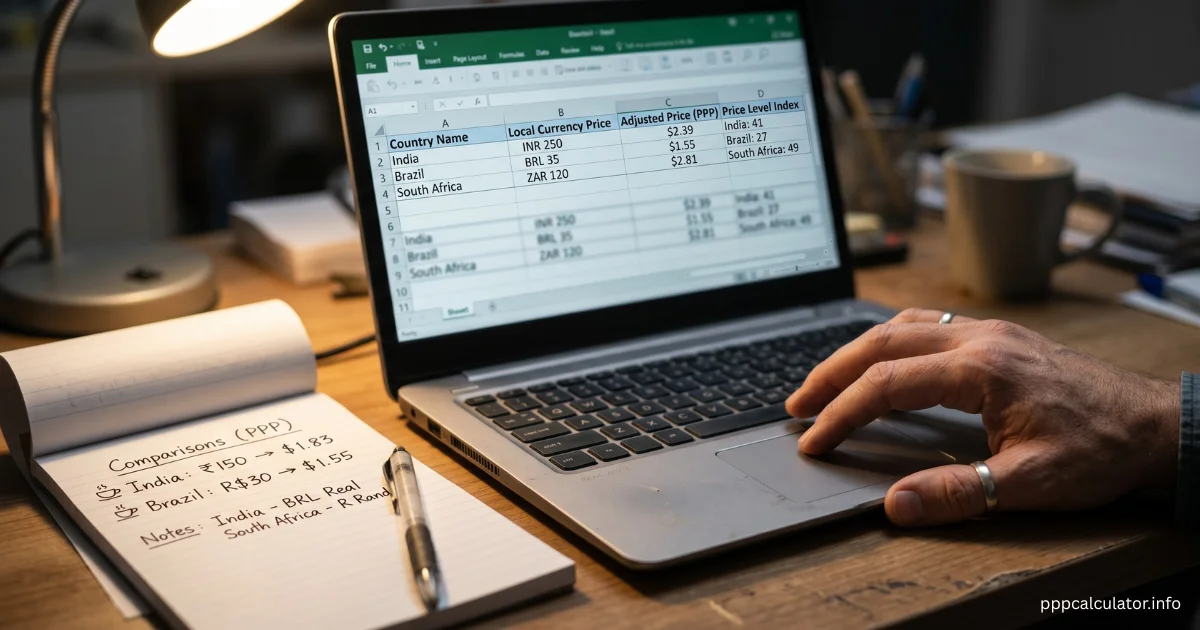
The World Bank publishes PPP conversion factors annually for 196 countries. These factors express how many units of local currency carry the same purchasing power as one US dollar.
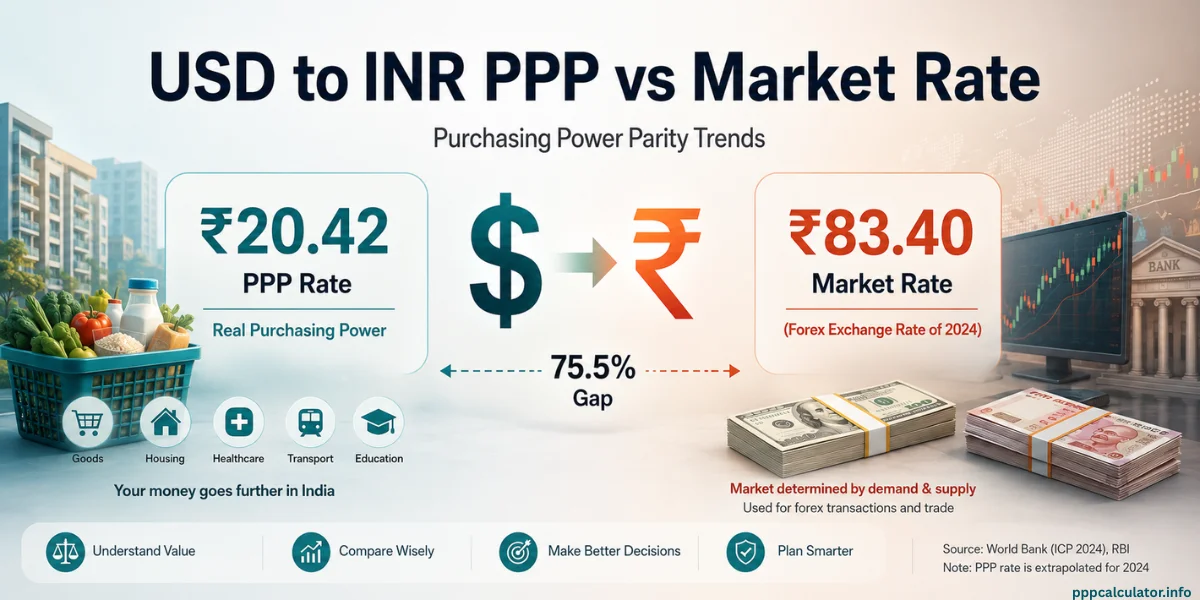
For 2024, India’s factor is 20.42, Germany’s is 0.70, and Brazil’s is 2.49. Using World Bank 2024 ICP data, you can convert any USD base price into a PPP-equivalent local price with a single formula.
Applied to a $10 subscription:
| Country | PPP Factor | PPP-Equivalent Price |
|---|---|---|
| Germany | 0.70 | €7.00 |
| Brazil | 2.49 | R$24.90 |
| India | 20.42 | ₹204 (~$2.50) |
| Nigeria | 176.33 | ₦1,763 (~$1.15) |
| South Africa | 7.43 | R74.30 (~$4.00) |
These aren’t discounts. This is purchasing power parity in digital products applied at the country level prices that represent equivalent economic weight in each market.
A Brazilian customer paying R$24.90 is spending the same proportion of their income as a German customer paying €7.00. Once that clicks, the next question becomes: does this actually work in practice, or is it just a tidy theory?
How Streaming Platforms Proved It
Netflix and Spotify don’t publish their pricing methodology, but the pattern in their actual prices matches PPP conversion data closely enough that the framework is evident.
Spotify’s Individual plan runs from $1.19 a month in Nigeria to $20.35 in Switzerland, according to the platform’s own country pricing pages tracked in April 2026, a spread of more than 1,600%. That isn’t accidental variation. It’s the World Bank formula in production, at scale, across 180 countries.
Netflix took the same logic one step further. Its pricing in Turkey, Mexico, and Brazil runs lower than PPP alone would predict, because a large share of what users in those markets watch is locally produced content, which costs far less to make than US or UK productions.
PPP sets the ceiling; local delivery costs push the price further down. The result is a product that feels affordable in every market it enters, and a subscriber base that keeps growing long after the high-income markets are saturated.
This is the proof that the model works. But seeing what Spotify and Netflix do with hundreds of engineers and dedicated pricing teams raises an uncomfortable question for everyone else: how does a smaller company actually implement this without the infrastructure?
Implementing PPP Without a Pricing Team

The answer is simpler than the streaming giants make it appear. Implementing purchasing power parity in digital products doesn’t require a dedicated pricing team or proprietary data.
The World Bank data is public and updated annually. The formula requires one multiplication. The only real decisions are which markets to prioritise, whether to price in local currency or USD, and how to handle the two situations where the model quietly breaks down.
The first is regional laziness. The most common mistake companies make is applying a single discount to an entire region. “Emerging markets get 40% off” is not PPP pricing. Brazil and Nigeria have very different purchasing power profiles. Vietnam and Indonesia differ by more than the broad “Southeast Asia” label suggests.
India’s PPP factor is 20.42; Pakistan’s is 66.96. Pricing them identically because they’re both in South Asia leaves significant revenue uncaptured in India while still pricing Pakistan out of reach. The World Bank data has a separate factor for every country. Using it at the country level, not the regional level, is what separates PPP pricing from a blunt discount.
The second problem is payment infrastructure. A Nigerian customer who sees a ₦1,763 price but can only pay with a card that adds a 5% international transaction fee and a $2 foreign currency surcharge ends up paying more than the nominal price suggests. The PPP calculation was correct; the checkout experience undid it.
Pricing at parity is only half the job. The local price has to clear without friction, in local currency, through a payment method the customer actually has.
Before you set a single country price, run your base rate through the PPP Calculator, it applies World Bank 2024 data across 196 countries and returns the equivalent local price for every market in seconds.
The Risk Nobody Sees Coming
Get the pricing right and the payment right, and there’s still one failure mode that arrives without warning: currency collapse. PPP conversion factors reflect structural purchasing power, not short-term currency volatility.
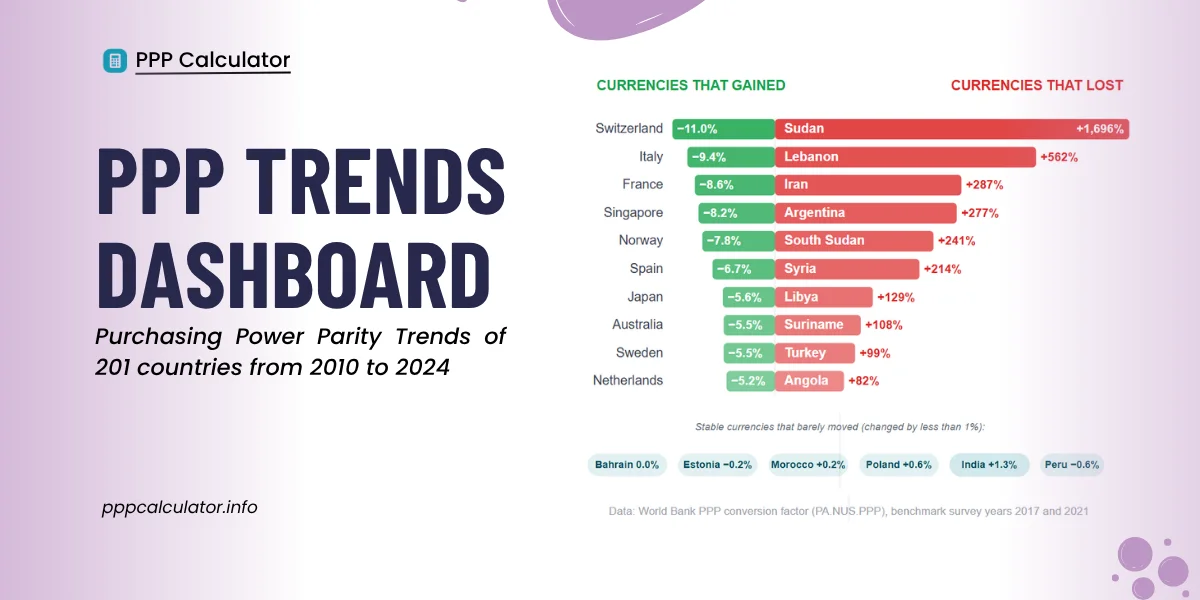
Argentina’s peso lost roughly 80% of its value against the dollar in 2023. Turkey’s lira ran annual inflation above 60% for two consecutive years. In both cases, local-currency software prices became artificially cheap in USD terms as the currency fell, then companies had to impose sharp corrections that felt arbitrary and punishing to customers who had done nothing wrong.
The companies that handled this better did one thing differently: they treated purchasing power parity in digital products as an annually reviewed framework, not a one-time setup.
The World Bank updates its conversion factors every year. A pricing policy that checks local prices against the current year’s data and adjusts incrementally avoids the cliff edge.
Small annual adjustments that track real purchasing power changes are invisible to customers. A sudden 60% increase after three years of neglect is not.
The Wrong Experiment by Most Digital Companies
Most digital companies already have the data they need to see the problem. Pull your analytics for the last 90 days and look at traffic by country. Then look at revenue by country. In almost every case, the traffic distribution and the revenue distribution will not match.
India, Brazil, Indonesia, Mexico, and most of Sub-Saharan Africa will show up prominently in traffic and nearly disappear in revenue. That gap is not a marketing problem. It is a pricing problem, and it has a number attached to it.
Take your base price, run it through the World Bank PPP factors for the countries where that gap is largest, and compare the result to what you are currently charging.
If the PPP-equivalent price for India is ₹204 and your current India price is the same $10 you charge in the US, you are asking an Indian customer to pay five times what the market can bear.
The conversion rate will be near zero regardless of how good your product is, how strong your SEO is, or how much you spend on acquisition in that market.
The fix takes one afternoon. The data is public. The formula is one multiplication. The companies running the wrong experiment are not the ones who tried PPP pricing and found it didn’t work. They are the ones looking at a traffic-to-revenue gap every month, assuming it reflects weak demand, and never checking whether the price is the reason.
FAQ – Purchasing Power Parity in Digital Products
No. PPP tells you what a price should be worth in each market. What companies actually charge depends on competition, content costs, and revenue targets. PPP is the starting point, not the final number.
A discount cuts revenue per customer. PPP pricing charges each market a price that represents the same proportion of local income, which grows total subscriber count without shrinking margin.
Yes, but conversion depends on the absolute local price, not just the discount. Below a local impulse-buy threshold it works well. Above it, customers deliberate and often don’t buy.
Check another important and useful article – Best Purchasing Power Countries for Digital Nomads in 2026

Jitender is the founder and lead developer of PPPCalculator.info. He created this free tool to bridge the gap between currency conversion and real purchasing power, helping professionals across 50+ countries make informed salary decisions. He regularly translates complex World Bank and OECD data into practical guides for remote workers and expats.